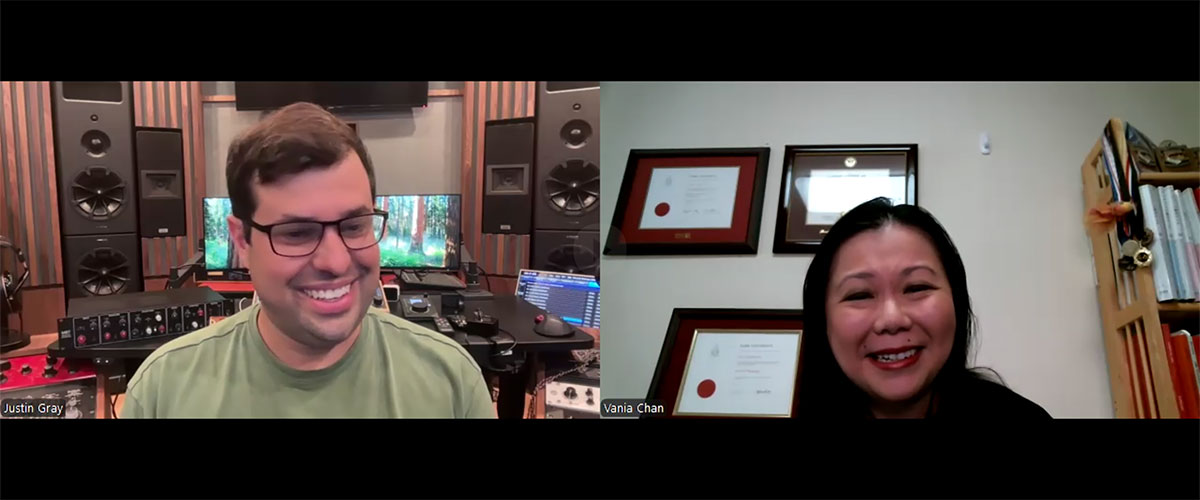
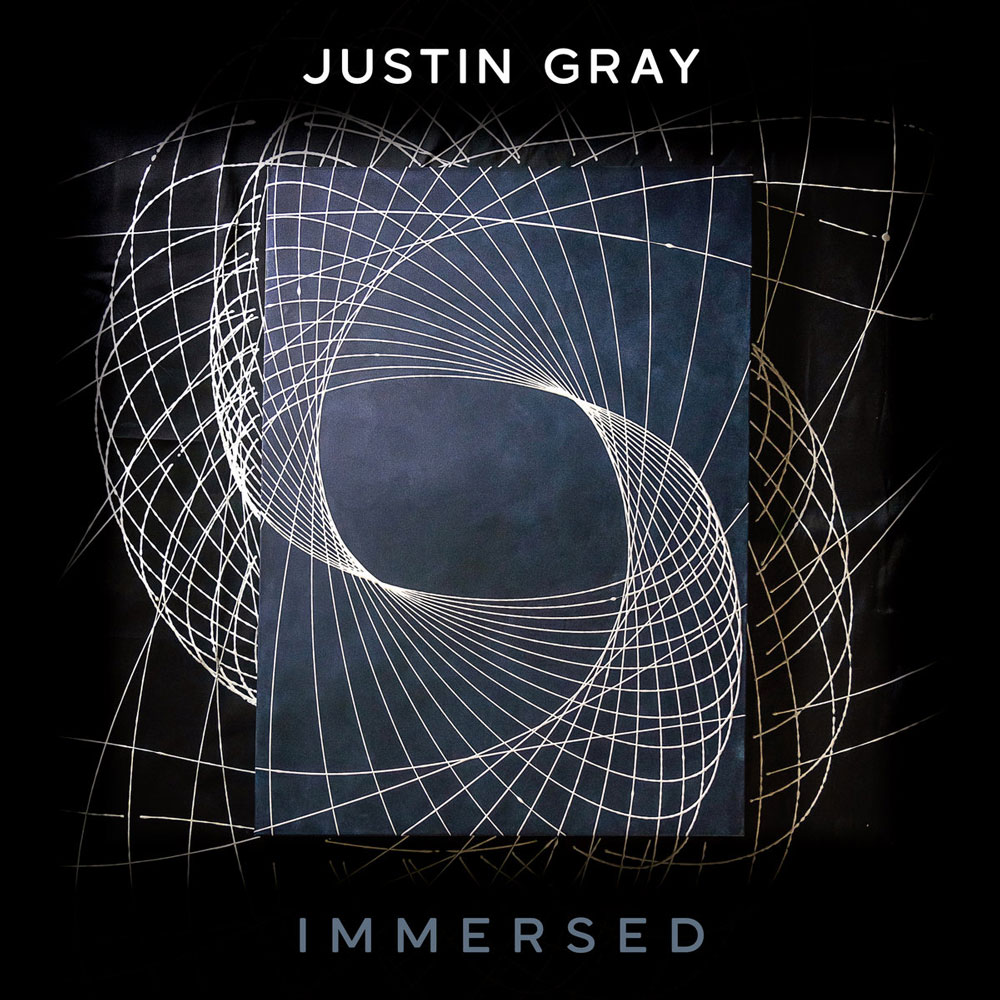
 Justin Gray’s achievements are globally recognized and lauded. In February of this year, the Canadian musician and producer won a Grammy Award for Best Immersive Audio Album for his record Immersed, an epic work that features 38 artists from around the world. Justin composed the music and recorded, mixed and produced the album in Dolby Atmos, which offers listeners a heightened experience, placing them at the heart of a 360-degree orchestra.
As a mix engineer, mastering engineer and producer, he’s worked on the albums of a multitude of artists in a wide range of musical styles, and inspires a future generation through teaching audio production, performance and composition at Humber College. In 2022 he won a JUNO for Group Jazz Album of the Year with the band Avataar, where he performed as the group’s bassist and worked as the producer and mastering engineer of the album.
His award-winning status notwithstanding, he continues to be the level-headed and even-tempered individual that I worked with in the Graduate Program in Music at York University, generously sharing throughout his interview, with great depth and reflective detail, lessons he has learned along the way. It never ceases to amaze me how the blossoming of even highly complex creativity can be anchored to a few simple yet profound truths: preparation, taking one thing at a time, and letting go. Or in the recurring language of these interviews – Calming the Mind, Organizing Thoughts and the State of Flow.
 Justin: I feel like the more prepared I am for the task, the less energy I have to use to think about what it is that I’m doing, and actually just do the thing itself – to be fully present, and to feel relaxed and calm and in the moment. As musicians, we work for years, decades, lifetimes even, to try to perfect the craft so that when we’re playing music, we can let go. When I’m doing something, it’s the only thing that I’m doing. When I can get into that state of focus with one thing, my efficiency goes up, my joy goes up, and so does my ability to focus more deeply.
By completely focusing on the one thing, you can make a significant amount of progress. When trying to juggle all the things at once, none of them actually move forward. I have studied stress in my life. When we interact with our emotions, we can learn to observe them. Some people do this through meditation. At a certain point I decided that my work is my meditation. A part of that process is to observe your thoughts, observe what is coming to you at any given moment. Things like self-doubt, fear, stress … I observe them, I feel them, and I practice letting them go. The more you practice that, and the more consistent you are with it, I find the less that they (stressful thoughts) come. The more we practice behavioural patterns, the more natural they become.
Invention: The observation of our own thoughts is an essential step in honing our ability to organize and structure our thinking. It allows us to de-clutter emotional distractions, leaving room for inspiration and invention to flourish. In addition to his many credits, Justin is also the inventor and co-creator of the bass veena, an instrument designed for Indian classical and contemporary world music performance. He collaborated with Canadian luthier Les Godfrey to co-design and build this one-of-a-kind instrument.
Justin: It’s a hybrid fretless bass, four-stringed with two extra drone strings, as well as a harp that is semi-sympathetic. I went through the thought experiment of asking – why create a new instrument? It’s almost like whittling away what it isn’t to find out what is actually needed and why.
Shortly after he finished his undergraduate degree, he told me, he went to Calcutta and started studying North Indian classical music, living and studying with a vocalist.
During that time, I found that the music demands certain inflections, specifically out of the voice, that allows us to move between notes freely. It’s kind of a necessity of the language. I was playing the music on a fretted bass [but] trying to work through that music with that instrument, I realized a fretless bass was going to be more appropriate, and I adapted. Through that experience I was searching for a sound … not a fancy looking instrument, not aesthetics, not even necessarily a technique per se … but rather a sound that I could start to imagine.
I was inspired! By studying the music, by being around the instruments – sitar, sarod, rudra veena … all of the Indian instruments, and how they’re being played by those great masters. That sound just kept evolving. I wanted to adapt my instrument in order to evoke this “melodicism.”
Through trial and error of drawing diagrams and having discussions, he discovered what he needed and sent his drawings to Les Godfrey.
And this is where the collaboration part comes. I can conceive of something, but then I hand it off to somebody who’s a master and allow him to interpret. Les is an artist creating stringed instruments out of wood. His ability to perfect the curves, understanding technically what is required to make this thing work and feel good. When the bass veena was done, I realized what had been made. I thought I was making something I could already play, but what that instrument has taught me since is what it’s capable of doing. At that point, I started to learn the instrument. Les built something so extraordinary. Every time I pick it up I continue to marvel at what it’s capable of doing sonically.
The thing about building this instrument … it’s not something you can just try multiple times, unless you’re financially in a position to do so. Les and I knew we had one shot at this. This process requires patience. It also requires acceptance. I’ve never ever again thought about what I could adapt on that instrument. That’s [partly] because it’s so well-built, but also knowing how to stop ourselves at a certain point and to accept. As creative beings we’re always looking forwards. It never stops if we don’t allow ourselves. There’s a lot of peace in accepting something, and actually just admiring it for what it is.
With his dream instrument in hand, Justin moved onto an even more ambitious project, his cinematic audio album Immersed, requiring an optimal psychological state of deep immersion in a particular activity. It’s a state we refer to in these interviews as Flow. For musicians it can feel like a heightened connection between the mind and body, a merging of action and awareness. Justin captured examples of flow state performances throughout this album, with the first track literally and aptly titled Flow.
Justin: The project is biographical. I drew upon my life experience of looking for that flow state. I feel very grateful to be able to go to that place relatively consistently. For the song Flow, I’ve spent a lot of time canoeing, and I’ve thought a lot about water … the beauty, and of course that it literally flows and can envelop us. I think often about sitting at the side of a river, where the rapids are happening – white water. The water hits a rock or some sort of obstacle and it separates from itself and takes on oxygen, so we see the white. But then, right after that, water effortlessly finds its way back together. It never stops working, even in the face of a waterfall or a boulder or a rock.
Flow is that beautiful state of doing exactly what you’re supposed to be doing, but also remaining completely lucid to adapting to the reality of the moment. Everyone on this project is exceptional at accessing that Flow state. My job is to help them feel prepared, sending them the music, giving them the building blocks – charts, references, etc. I set up the environment so that they feel comfortable and inspired, to facilitate that flow state. I prepared everything, and then I just press record. I stay there, I’m with them. We didn’t over-rehearse the music. I wanted them to be in that discovery mode. I trust them and they trust me to guide this process, to get us to that flow state that we’re searching for. My job as an engineer and a producer was to capture those magical moments and to organize it afterward as a body of work.
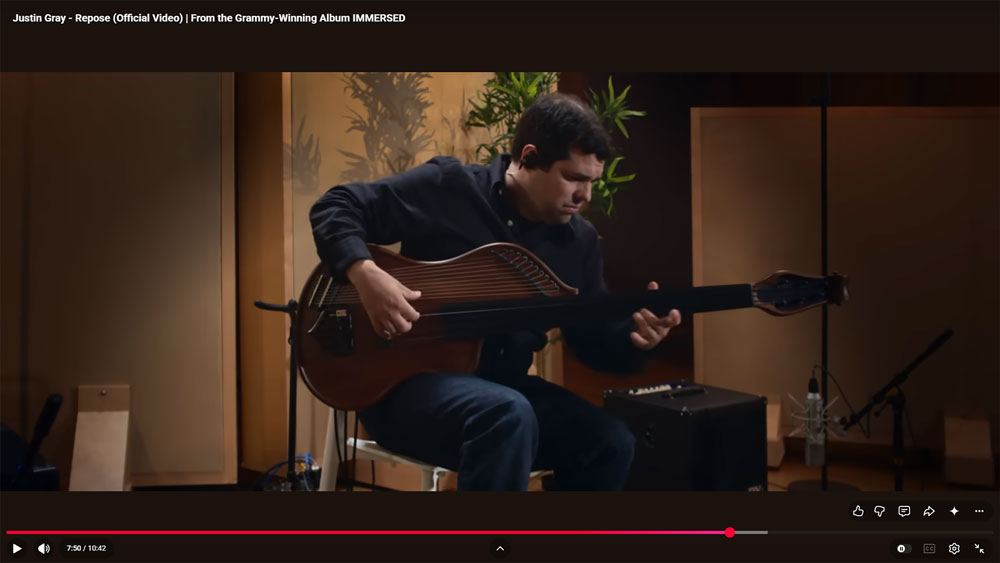 Justin’s full interview is available in its entirety, alongside past featured artists’ interviews, on my YouTube channel – Vania Chan Music.
Up Next: Brian Current – Composer and Conductor
Author and creator of this series, Vania Chan is a lyric coloratura soprano, artist researcher, and educator. Visit her website: www.vaniachan.com to learn more about upcoming projects.