

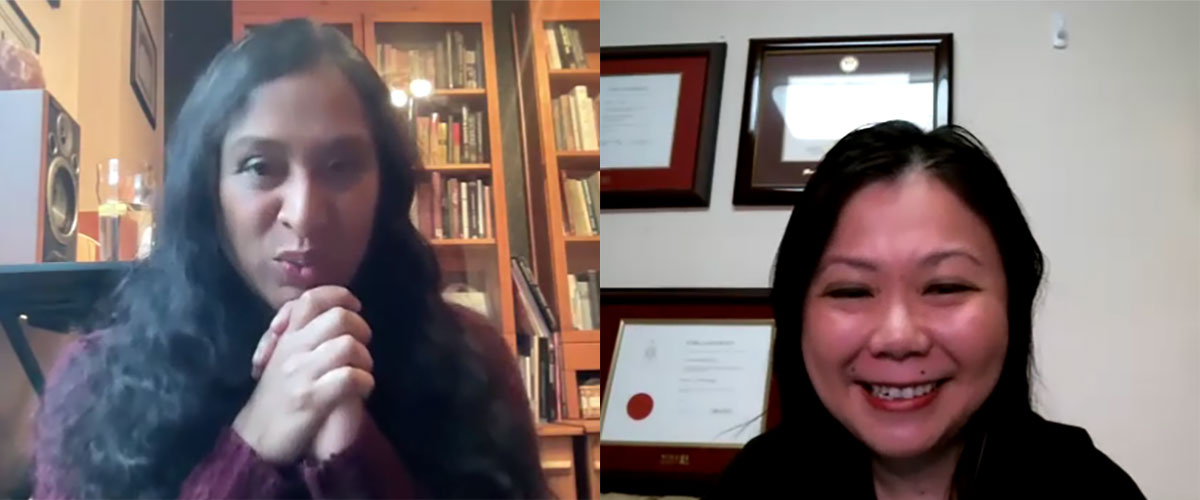
 The need for connection is constant and ever present in life, and artists are particularly sensitive to that need, which is why I started “When Music Meets Mindfulness” – to have conversations with fellow artists that encourage us to learn from each other, to ground us, and to keep us anchored in a fast-paced world that often threatens to sweep us off our feet.
In this conversation with multi-talented world/fusion artist Suba Sankaran, I found myself uplifted and motivated by her warmth and nurturing presence. She emanates joy as she speaks about what she loves to do most – reaching out and connecting through honest artistic expression, as a performer, a choral director, educator and arranger. She has composed and produced music for music theatre, film, radio and dance including collaborations with Deepa Mehta, the CBC, Stratford Festival, Shaw Festival, and the Barbican Theatre in London for the debut of her original music for Why Not Theatre’s Mahabarata.
Through all these career-defining moments, she remains the same deeply rooted person with an open heart and voice that I met years ago at York University, where we shared a connection: membership in the collegiate a cappella choir Wibijazzn’ (now known as WIBI). We were not in the choir at the same time; nevertheless the legacy of the group initiated a bond between us, and has opened up opportunities to collaborate, including this interview.
As always in this series, the three principle precepts of Mindfulness – Calming the Mind, Organizing Thoughts, and Flow – provided a roadmap for our exchange.
Calming the Mind for Suba entails carving out precious time and space to engage in self-care and intrinsically motivated activities: “a concerted effort for my own well-being to engage in daily practices” she calls it. She starts her day with yoga and also finds it helpful “to set aside protected and sacred time and space for creativity to flourish.”
Yoga [means] union – of the mind and the body, and the voice as well. When I practice, it could be specific to upcoming concerts, but it could also be a time for creativity to flow through me. I spend my time composing or arranging, or practising piano, voice, and percussion – those are my three main instruments, especially the voice as my primary specialty.
I like to cook and spin vinyl at the same time. I also have a love for gardening. It involves tending to life and it’s a way for me to be really close with the earth. Cooking is that way too. A feeling of gratitude for those who have toiled the earth to bring this abundance to me and then I can do something interesting with it and use my improvisational skills as well. I love walking and hiking and fair-weather biking. That’s the place where I can collect my thoughts for future concepts in programming or future compositions. Every one of these aspects serves as a form of meditation, be it physical, mental, emotional or something that is beyond my comprehension.
The topic of Organizing Thoughts led us to talking about Suba’s work as an Artistic Associate of Confluence Concerts - a curator of unique musical programs, primarily at Heliconian Hall. This past April her Confluence program was titled “Mandala: The Beauty of Impermanence.” Her Confluence program later this year, on September 26 and 27, is titled “Global Voices.”
I like to think of myself as living and thriving in the spaces in between. I strive to find the points of intersection, what I like to call connecting the “cultural dots” between styles and disciplines, figuring out how I’m the constant in that ever shifting musical landscape. Everything I create is an expression of and a search for a deeper understanding of my identity as a hyphenated Canadian with a South Indian background.
Shows like Mandala – it means “cycle” or “circle” come directly from my Hindu upbringing, taking me back full circle. We see it in nature – the ebb and flow of the tides. We feel it in the inhale and exhale of breath. In music we see it in cycles and circles as well. It could be a ground bass, a (musical) round, an ostinato pattern, a rhythmic cycle.
With “Global Voices” I am searching for my own identity, through my voice. The program showcases the many traditions and cultures that global divas here in Toronto have to offer. It includes the band “Turkwaz”, a world and folk music ensemble featuring Maryem Tollar, Brenna MacCrimmon, Jayne Brown and Sophia Grigoriadis. They cover Arabic music, Egyptian music, Mediterranean music and music of the Balkans. Through connecting the cultural dots, it makes the world so much smaller. We find the interconnectedness of cultures, as opposed to this culture versus that culture. It’s all about being with, not against.
Going through these projects … helps me make sense of life and the world around us. That’s the thing about the beauty of impermanence – the whole idea is that it’s all about the process, not the product. It’s very much about what happens when you are absolutely in the moment…
The segue into Flow, our final topic is effortless as she opens up about the mind-body connection whenever she shares the stage with her father.
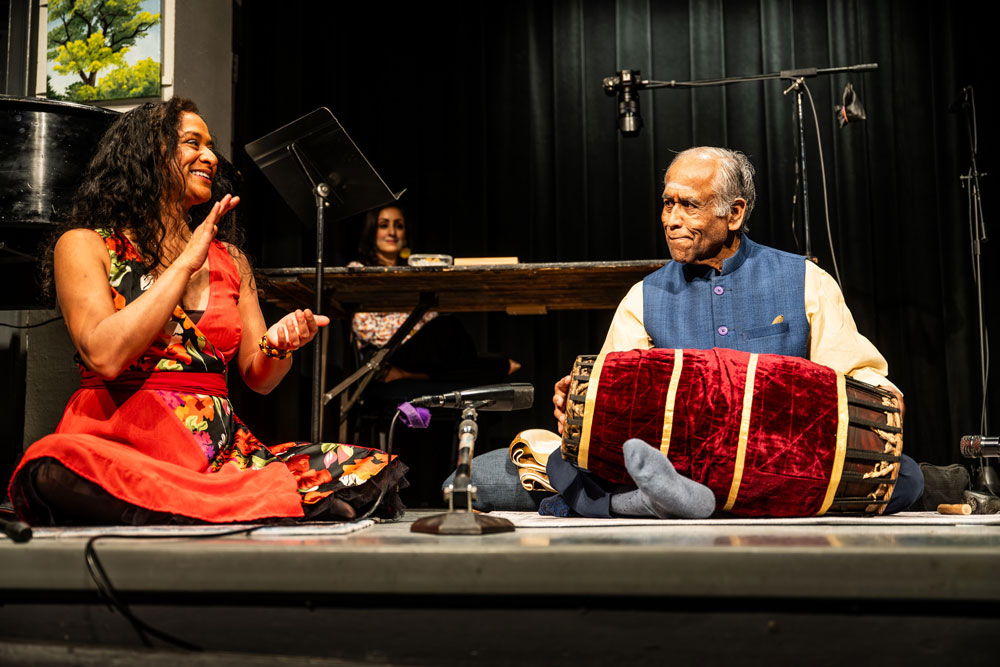 My father, master drummer Trichy Sankaran, was a child prodigy of the Mridangam, which is a barrel shaped drum from South India. He’s been a leading exponent in this particular instrument and was a professor of South Indian studies at York University before he retired in 2015. Any time I’m on stage with him, I feel that sense of flow. I feel it through him, and I’m sort of able to catch a whiff of that, and feel it inside myself. There’s actually a word in South-Indian music called “Laya”, which means “flow”. It’s like being in the ocean and going with the tide. Or it’s like that moment when you’re doing double-dutch and you know exactly what to do to get in the centre of those skipping ropes.
I feel it all the time when I’m singing my South Indian Classical music with my father. When he’s doing a drum solo, for example, I’ll be keeping the rhythmic cycle, or the rhythmic flow. That’s a very important job in South Indian music, keeping these codified hand gestures, while the solo is going on top of it so that every little syncopation can be felt. You end up riding or surfing on a wave of sound and experience, which I think is really beautiful.
There is absolutely a cyclic flow and feeling to my work. I think everything informs everything else. I just love spending my time figuring out what those connections are. Things that are happening to me in daily life, interactions that I have with other people, will often make their way into my compositions. Teaching often informs what happens on the stage and vice versa. What I’m doing in my tour might come back to my community choir. Everything feeds each other and helps it blossom and flow.
For me, it feels like a very…I don’t want to say simple formula…but it does feel straightforward. I love my work, I love the art that I do, and that makes work feel like play. I get to do a lot of that with my husband Dylan Bell, which is also extremely fulfilling. And so, I find those concentric circles between my work, my social life, my family life, and my creative life. It all feeds each other. I’m just deeply, deeply grateful to have this opportunity in life, to bring my music to people around the world. That they’re willing to listen, and that I’m able to give them something honest and raw.
All the featured artists’ interviews in this series are available in their entirety on my YouTube channel – Vania Chan Music.
Up Next: Justin Gray - GRAMMY® award winner for Best Immersive Audio Album “IMMERSED”.
Author and creator of this series, Vania Chan is a lyric coloratura soprano, artist researcher, and educator. Visit her website: www.vaniachan.com to learn more about upcoming projects.

