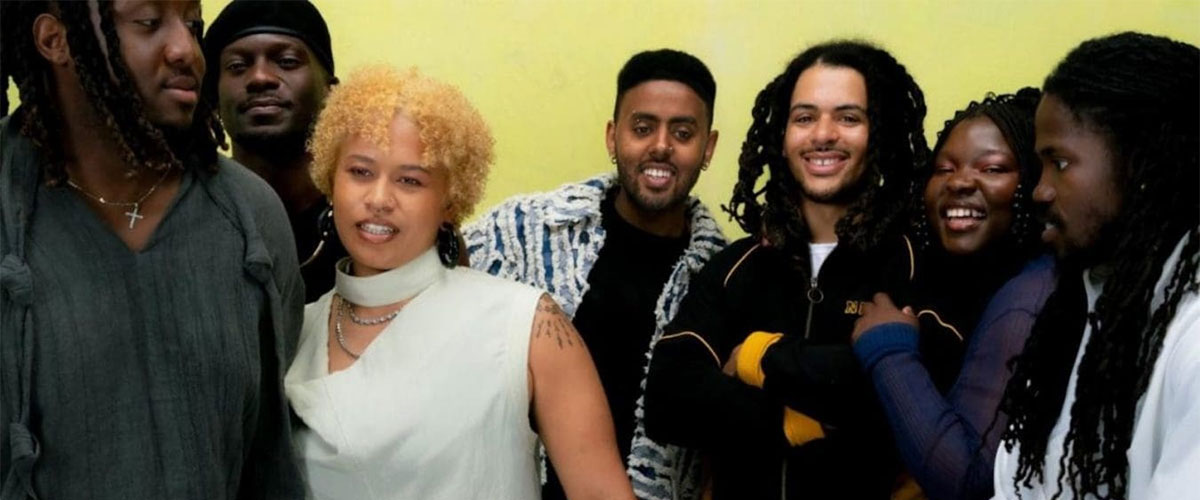
 In the May/June WholeNote, see page 20, I wrote about the eight-piece band Kokoroko, a revolutionary group of young Black musicians from the United Kingdom, coming to the Toronto Jazz Festival for a June 25 appearance at the Phoenix Concert Theatre.on June 25, Toronto. My first image of them was ten or so years ago – a photograph of a frontline of Black women horn players - trombone, trumpet and saxophone. It looked like it could be a jazz band, but when I finally heard the music it was not landing as such to me.
It turns out that the origin story of Kokoroko is firmly rooted in afrobeats. This music, out of Nigeria, names as a source Fela Kuti, who blended highlife, traditional African drums from Nigeria, American funk, electric instruments, and lots of horns. Since then, Kokoroko have continued to expand compositionally: elements of hip-hop, gospel, palm-wine, soca, Jamaican sound system, and yes, jazz, with all these influences beautifully woven into an original sound that includes the original hornline-infused afrobeats of Fela Kuti’s era and highlife, along with hip-hip, grime from London’s electronic dance music scene, dancehall and gospel.
As a music writer, I’m interested in process, how they compose, and so I dug further into this in an interview with co-founders trumpeter Sheila Maurice-Grey and percussionist Onome Edgeworth.
Kokoroko means “be strong” in the Urhobo language from southern Nigeria. I don’t know what they have in store for us on June 25, but judging from the soca-influenced “Sweetie”, I strongly suspect we’ll all be singing, “Sweetie make my heart beat bounce!” In these challenging times, I anticipate a joyful gathering. There will be much dancing.
THE INTERVIEW
Gloria Blizzard: Fela Kute has just been inducted into the rock and Roll Hall of Fame. Did you hear about that?
Sheila Maurice-Grey: No. Crazy!
Onome Edgeworth: It's late.
Maurice-Grey: Yeah, it's late. We are now hearing about it. I think it is amazing. Everywhere we've been, someone mentions Fela’s name. It’s good to have that as part of our story. It's just amazing to see how, how much his legacy is still living on. I don't think it's going to ever diminish or die. Afrobeats is really stemming from that music, Fela’s high life Afrobeats.
On legacy and audience building
Edgeworth: With African music and reggae in Europe, I can't speak for Canada, but I would imagine this may be somewhat similar, often when an African band, whether it’s Baaba Maal or Fela Kuti, played at festivals that definitely weren't black festivals, the attendees were often a very open-minded white crowd. It's wonderful that they had this amazing time to tour, however, there was also a sadness for us that young Black people weren't interested in this music. Growing up, you'd hear it in your house, but you wouldn't pay to go to a gig of this music.
Maurice-Grey: We wanted to shift that. We wanted it to feel different. I would go to gigs here (in Europe), and there’d be maybe one African in the room. The whole band would be English and the whole crowd would be English. I loved that the music was kept alive and there was a scene for it and people were interested, but also I wanted it to reach our community. I felt like we were the missing part of a thing that was actually ours.
Edgeworth: It was big for us to try and move that. We've been around that 10 years now and the crowd is drastically different. Young people all over the world are playing not only West African music. There are now so many young East Africa and South African musicians and jazz musicians thriving amongst young people. It’s a beautiful shift and we're happy we're a part of it.
Maurice-Grey: We don't shout about being an all-Black band, but our pictures do. We are conscious about our visuals. We think about what will draw people to our concerts. Whenever we go to America, our crowds are very Black. And even Canada as well, which is really shocking for us. Especially coming from Europe. London's not too bad. I think sometimes you can get more of a mixed, um, audience, but it is really, it is a lot harder. So yeah, it’s been amazing seeing people come and support us.
Edgeworth: We’ve quite deliberately done like free gigs in places and tried to build community. How do we get as many Black women or people from our community in the space in a positive way. One of the beautiful things about cities like London, Toronto is another one, is that you grow up amongst everyone and like, there's this common understanding in the city where cultures cross and mingle. Part of what makes you appreciate your culture so much that you live amongst other cultures. We never want to exclude anyone. We try to maintain that, but we are also super welcoming whenever we can be, to young Black people, young Black women in any way we can be.
On the band’s longevity
Maurice-Grey: We started over 10 years ago now. We were in our mid-twenties to mid-thirties now. Some of us are now reaching the big 4 – 0. Johan the bass player always says his whole time he spent more time with us than his family. I think we could all kind of say the same. We’ve been through a lot with each other, but I would not trade this experience for anything. It’s left such a massive imprint on my life and everyone around us as well in some way.
Edgeworth: It's given me a deeper understanding of how time works and how like watering something and feeding something, even when it feels like it's not giving you anything back, it does return something. It's brought a lot of calm to my life seeing that.
My mom always talks about seven year cycles and I try to listen to her when she talks because she tends to know. With seven years of doing something, you've seen it be really hard, you’ve come out the other end and you've also seen the value in it.
I think it's allowed all of us in the band to understand like the power we have and impact you can have like on the world. It doesn't have to be desperate. It can just be holding space and working hard on something that you believe is right. There's a real peace in knowing that gentle movement, moving towards something is the right thing, and just continuing this lands you where you want to go.
On staying true
Maurice-Grey: We try to be as integrous as possible. Our careers could have gone so much further, but we were being true to ourselves.
Edgeworth:
We said ‘No’ to many things. I don't think we've regretted a single No. Anytime you feature or collaborate with someone it should be an extension of the story you want to tell, or something that your heart is telling you. It should feel great. As soon as that's not there, the heart is gone, it's just a job. We’d all would rather make bad records than sacrifice our, ourselves for that.
On composing both meditative and danceable music
Maurice-Grey: Our first song that ever went viral was ‘Abusey Junction’. And that was a happy accident. When we wanted to record it we couldn't find a drummer. I think it was your idea, Onome. You said, ‘let's just do this without drums’. That highlighted the importance of having music like that.
We've had those two parallels from the beginning, which is having like those slow moments and then having the really up moments. Recently we were trying to change our set and one of the guys said, ‘You need to make up your mind. Is it gonna be either really slow or really fast? It has to be one oR the other.’ And I think we were like, no, it doesn't.
We can lean into both the yin and yang. I don’t know if I should even make it gendered, but it does feel like masculine and feminine energy.
On the creative process
Maurice-Grey: We all write and everyone writes differently. When we've been writing recently, it generally starts with groove. With drums, a drum machine.
Edgeworth: Sheila and I have this idea that everyone has like an internal pocket that you're kind of maybe born with. Every country, even like micro-parts of a country have this groove and rhythm that's you. You could deviate from it, but it's hard. And I guess that finds its way into all of our music.
I'm from Delta State in Nigeria. It sounds like when I play the drum kit, everything pulls back and I want everything to be slow and moving. And then when I listen to music from exactly where I'm from, all the groove is also so far behind.
Maurice-Grey: It’s so behind. I can't play behind.
Edgeworth: Sheila, she always wants to write these, these playful songs. And grooves are very straight and on. She is from Sierra Leone. I've started finding music from Sierra Leone. It's all straight and it's all straight and on! On some parts, but you start every line slightly ahead of the one. So I think we all have this internal clock and like, what's nice is. We're always fighting with one another's groove. And letting that actually exist in the final takes is what kind of makes our music unique. Sometimes, it’s genuine mistakes and we're not quite fitting together. But that's the story of seven people recording and sometimes, there's a line that you just let exist.
Things feel very human and the places where it's broken just makes you understand that this is humans playing it. There's a beauty and a wrongness to this. I think that's like a magical thing to preserve.
On their new album Tuff Time Never Last
Blizzard: The latest album, Tuff Times Never Last. ‘Tuff’ seems like a nod to Bob Marley. The first track, ‘Never Lost’, which sounds very much like reggae. Was that a deliberate reference, an homage to Marley aka Tuff Gong?
Maurice-Grey: It was, and it was one that I was fighting against because I was like, ‘tough’ needs to be spelt properly. In my mind I was like, in 10, 15 years and you see ‘Tuff’ in my mind I was like, are you, are we trying too hard to be cool?
Edgeworth: Caribbeans and Africans, we all came to the United Kingdom around the same. It's always gonna be Caribbean in London. You've got like the Calypso and all of that that filtered into African music at the time. Jamaicans had a massive impact here on our slang, how we talk and with lovers of rock music and the sound system culture here, grime music, and a lot of the hip hop. I grew up in a reggae house.
On Kokoroko’s world tour and making their way to Toronto
Maurice-Grey: We were in Scotland. We are touring Southern Africa playing Cape Town and Joburg. We're gonna do La Reunion, an island close to the coast, and Mauritius. Taiwan and Japan are confirmed. We might be going to Australia again, and hopefully South America and the Caribbean as well.
Edgeworth: Toronto feels like a twin city in a lot of ways. People have an understanding that the world feels very similar to that of London and maybe New York. The cities have a similar perspective as they're all so diverse. No one's from where they are. It’s sick how cultures meet and, and we like got a lot of friends over here or people that we work with that are from Toronto that just have like good energy and they're so positive and, and up for working and connecting. It is just, it reflects the city very well. And the shows are good, man. People come out and support and it’s a big creative audience as well. A lot of young people that are in our field, in our world come and support the shows. Yeah.
We love Toronto.
This interview has been edited and condensed.