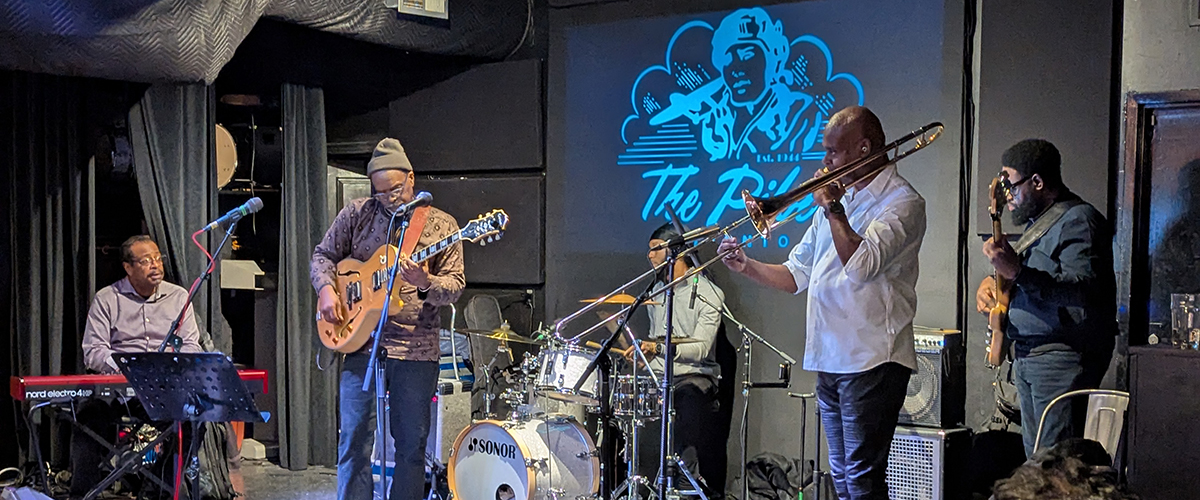
 I didn’t want this to be the story, but it is the story. Jazz, segregation, the Musicians’ Union and why jazz and Black musicians at the Pilot (and other venues) are still a big deal.
To begin, let’s be joyful. From January 31 until the end of February, the Pilot Tavern hosted an event each Saturday, featuring Black musicians in Toronto. This series is the brain-child of Trevor Bazilio, long-time attendee at the venue, who queried the paucity of Black jazz musicians being featured. Four years ago, he proposed a Black History Month (BHM) celebration that would feature Black band leaders and musicians during February, and was invited to book it.

A step back
The Pilot Pub was first opened in 1944 by the Klashoff brothers on Yonge Street. This was the era of wartime patriotism. The opera Transit through Fire: An Odyssey of 1942 would have been on the radio airwaves, and Gilbert Watson’s orchestra would have played the dance pavilions. The name of the pub was a nod to the World War II military pilots. At this time, women didn’t commonly frequent pubs, so we can only assume it was a drinking establishment for the men in downtown Toronto. And because it was 1944, we can assume that it did not include Black patrons in the largely segregated era in the city.
In her thesis project, Listening to Photographs in the Archie Alleyne Archive: Black Musicians in Segregated Toronto, 1940-1960, PhD candidate Keisha Bell-Kovacs studies the social context within which jazz evolved in Toronto. Archie Alleyne (1933-2015) was the Canadian jazz drummer, band leader, advocate and activist for Black jazz musicians in Canada who donated his collection to York University.

Many of the photos were taken at the Universal Negro Improvement Association (UNIA) location at 355 College St. “These jam sessions started in 1951, and they were integrated. It’s great you see this room full of Black and white people in these photographs. It was one-directional integration,” says Bell-Kovacs. When those local Black players walked out of the frame of the photograph and onto the streets, they did not have access to many other venues or even the Musicians' Union.
“The history of jazz in the city is also connected with prohibition,” she says. “The first cocktail bar, the Silver Rail, opened in 1947, and with it came a desire to bring a sophisticated element to drinking alcohol. Prior to that, you had to go to pubs to drink. With this different environment, there was a sudden surge of interest in having jazz musicians from the United States come to the city to play in them.”
“Count Basie came regularly to the city. Duke Ellington came,” continues Bell-Kovacs. “He had the cultural capital of being Duke Ellington, and he could play the venues, but still, he and the other Black musicians couldn’t stay in the hotels. They were billeted with Black families. Black Canadian musicians were just not booked to play.”
The musicians developed elegant ways to ensure that, at times, their Canadian colleagues could join them on stage. A ticket would be left at the door (along with a few dollars – payment ahead of time) for said musician. The American musician would suddenly notice the Canadian player in the audience and encourage the audience to encourage this great Canadian musician to sit in.

Pubs and taverns to cocktail bars and dance clubs
“I worked with Archie Alleyne for a long time, I was his sort of writer-for-hire,” says Toronto writer Edward Brown. “Archie told of sneaking into such venues, ‘breaking the colour barrier’. He’d always reminded me that he was the second Black musician to join the union. The Musicians’ Union was adamantly adamant against having Black members. They didn’t even hide their racism. They said it outright. Archie did a photo exhibit, and I wrote the accompanying booklet about vocalist and pianist, Valeire Abbott Hunt. I think she gets overlooked because she is female. She was actually the first Black musician to become a member of the union.”
In the 1940s, the Palais Royale on Lakeshore Boulevard was a dance hall where the American big bands would play. It became a site of protests led by musician and later surgeon, Douglas Salmon (1923 – 2005) and the Race Discrimination Committee. Black people also wanted to listen and dance to the Duke but were excluded.
The first Black Canadian to be booked into a club was pianist and bandleader Cy McLean (1916 – 1986). He played the Colonial Tavern in 1947.
“I always wondered, why Cy McLean? What did he have that the other musicians didn’t? And I found an interesting story. He had a friend and booking agent, a white guy, Douglas Widdess (1905-1986). Widdess was a sax player turned agent, who at that time, worked for Norman Harris Artists Agency Ltd. He’d advocate for Cy McLean to get work, and he’d be shut out. Widdess eventually said that if his friend couldn’t play the venue, neither would anyone else on his roster. So, Cy kind of had the silent backing of this promoter agent. The steps to overcoming injustice are not ever done alone. We need to work together.”
Archie Alleyne soon brought his own band to Toronto venues, following in McLean’s footsteps.
Aviation and Jazz
I thought this would be an article about some deep connections between aviation and jazz. That’s not the article that’s emerging obviously. Those connections are more in my personal experience and associations … a pilot father who played jazz recordings constantly at home (along with Calypso and other genres).
The early iteration of Pilot Pub on its Yonge Street location was a music-less venue. There was a name change to Tavern when cocktails became popular, and women were allowed on the second floor. By the 1960s, due to its location between several art galleries, it became a hub for visual artists. “It became a meeting place, where after the sale of a painting at an opening, an artist could wander over to the Pilot to cash their cheque and buy drinks for their friends,” laughs Steve Conover. Musician Gordon Lightfoot and writer Austin Clarke are amongst a couple of notable artists who like to hang out there as well.
Conover is one of the trio of friends from Jarvis Collegiate who bought the business in 1988 after the land under it was expropriated. He tells of regulars helping carry the original wooden bar on foot, up Yonge Street, across Bloor to its current location in a former car garage on Cumberland Street. Here, the trio extended the pilot/aviation theme, with black and white photos from the Royal Air Force archives and aluminum stairs that mimic the airstairs from a plane to the tarmac. Without a formal architect, they found ways to convey a feeling and reinforce the name.
Conover is a musician and jazz enthusiast who recalls going to the Colonial Tavern as a teen, “It had two storeys – a restaurant (not licensed) and a bar (licensed). Young people could see Cannonball Adderley for tea and some rice pudding – along with Dizzy, Roland Kirk and many others.” He went on to study bass at the York University jazz program. In the 1990s as part owner of the Pilot, he floated the idea of booking jazz once a week.
As the booker of this new jazz venue, he was able to book Archie Alleyne and his band Kollage regularly, every two months or so, for about six years.
Perhaps Alleyne’s dedication to his regular gigs at this venue were part of the impulse to take up space. With a living memory of when there was absolutely no space for such ensembles, it would have been important to maintain a Black presence on the jazz scene after the American circuit died. “Archie missed one gig for his father’s funeral,” says Conover. “It was Trevor Bazilio’s idea to do Black History Month programming. It builds on this legacy. The events are successful, and grow every year,” says Conover.
Words and deeds
There were many others at work on changing the jazz landscape. Howard Matthews and Salome Bey owned the 1st Floor Club. The Underground Railroad Restaurant and many other venues ensured environments where Black audiences, with an embodied knowledge, even if not explicit teachings of the history of segregation, could feel at ease.
The mechanisms of omission or oversight, however, have not been shaken. This intersection of gaps and absences in both bookings and opportunities for Black Canadian vocalists and instrumentalists is explored more fully in the article I Stand On Their Shoulders: My Love Letter To Toronto’s Black Jazz Musicians by musician Shakura S’Aida.
Five nights of Black jazz musicians programmed to play at the Pilot Tavern, a jazz venue, calls attention to an absence in the musical landscape. The absence of Black women musicians in the programming, however, is perplexing. Both scenarios indicate some of the cultural patterns that persist in the jazz scene in Toronto.
“Our words speak, and our deeds speak,” says Edward Brown. “What you see on the stage represents the truth in that sense. What we see on the stage is representative of what our culture thinks.”
I’m part of the culture, and I’m thinking, so here’s my pitch for next year: Shakura S’Aida sings Nina Simone or Lena Horne or whomever she wants; Keisha Bell-Kovacs, pianist, plays Hazel Scott; Joy Lapps-Lewis, composer and pannist, plays tribute to Othello Molineaux and Rudy “Two Lefts” Smith; Faith Amour, vocalist/flautist and Sheba Thibideau, bassoonist bring their own ensembles.

Change is a constant. The Pilot Tavern has changed hands once again and is now owned by Daimin Bodnar’s One Duck Hospitality. This comes with an updated sound system on the second floor that can seat a larger audience. For the BHM celebration this year, Bazilio expanded the programming to include ska, funk, poetry by Stedmond Pardy and a presentation on Oscar Peterson by Edward Brown and George Elliot Clarke, opening up the celebration to a wider range of listeners.
Poetry at the Pilot?
At the Saturday, February 21 BHM matinee, Maurice Gordon’s Skafire Roots had the audience hopping, dancing in a long line, winding between the tables of a full house – an unusual scene in what has been, for many years, a jazz venue. Gordon and the band (Don Laws – trombone, Michael Kennedy – bass, Austin Rowe Jr. – drums, Rickie McIntosh – keyboards) led the audience through a retrospective of ska hits. “It’s pronounced skya,” said Gordon, and had the audience practise how to say it correctly. They played tributes to Jamaican musical legend Jimmy Cliff, with songs from many famous bands, including the Skatelites, ska versions of pop songs like My Girl Lollipop, Bob Marley, of course, and some original tunes.
After the first set, poet Stedmond Pardy took to the stage. Pardy told me afterwards that he was nervous performing for a crowd that came out to hear music. He holds, however, to the words of Amiri Baraka: “You should be able to read your poems to construction workers and if they don’t smack you over the head with their helmets, you know it’s pretty good.” The Pilot audience responded with laughs at the right places, finger-snapping and enthusiastic applause.
Pardy’s unique presentation includes powerful images and percussive vocals. He spoke, amongst other things, of the landscape just outside the doors of the venue in his poem about Yonge Street: “What did you do to the Big Slice and the Colonial Tavern and HMV? Why are you dolling yourself up like a cut-rate Times Square?”
With parents from St. Kitts and Newfoundland, he is drawn to musicians, like Lenny Kravitz and Phil Lynott, with similar mixed backgrounds. He also lists Jimi Hendrix and Iggy Pop, and the Stooges as inspirations, and saw the latter perform at Massey Hall in Toronto. “They really knocked me out, in that they were in their 60s, still breaking the 4th wall, and when you left it, it was like a power surge out there.” Jazz is also a big influence. He lists Thelonious Monk, Duke Ellington, and Coltrane, and recently performed one of his poems with Canadian jazz musician D.D. Jackson, and has a limited edition book-cd coming out soon.
“It’s been a great honour to be amongst first poets to grace the Pilot stage during Black History Month”, says Pardy. Let’s hope there will be many more.
Gloria Blizzard writes on music, dance, culture and is the author of Black Cake, Turtle Soup, and Other Dilemmas.