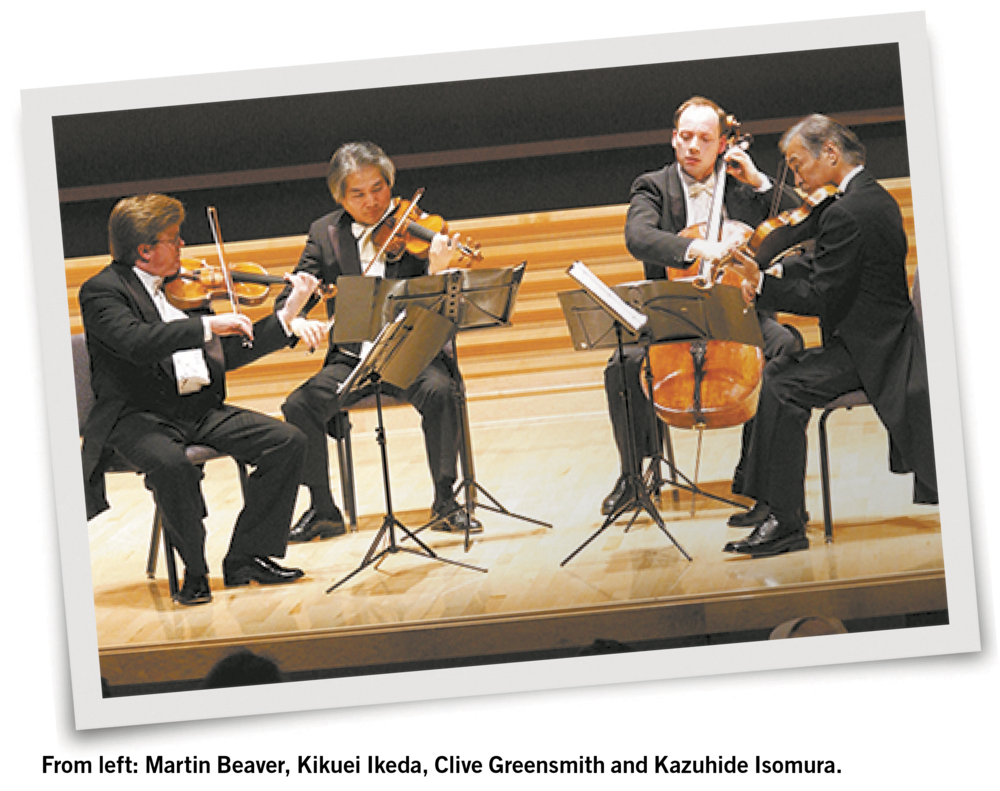
 There was a heightened sense of anticipation in Toronto’s Jane Mallet Theatre as the Tokyo Quartet walked on stage for their concert in January. This was the 45th concert the quartet had played in Toronto since their first visit 37 years ago. But it was by no means business as usual. They had just announced that this season would be their last.
Earlier that day I had a chance to talk with the four members of the quartet, first violinist Martin Beaver, second violinist Kikuei Ikeda, violist Kazuhide Isomura and cellist Clive Greensmith. Both Isomura, who was one of the founders of the quartet in 1969, and Ikeda, who joined five years later, had played in that first Toronto performance. After a few other changes in personnel, Greensmith joined in 1999 and Beaver three years later.
As we talked over lunch, I was struck by how intently these four very different individuals listened to each other. They finished each other’s sentences, embellished each other’s stories, commented on each other’s thoughts and recollections, joked with each other, and laughed a lot. They just seemed to enjoy each other.
After their final performance in July at the summer home of the Yale School of Music, where they have taught for many years, the quartet will disband. Fortunately, before that, they’ll be back in Toronto in April to give two more concerts.
Pamela Margles: Does performing in Toronto hold special significance for you?
Kazuhide Isomura: Yes, we feel that visiting Toronto is almost like coming back to our second home. The Tokyo Quartet’s base has always been New York — we started the Tokyo Quartet in New York, and New York is our home. But we have had such a wonderful relationship — partnership — and friendship with Music Toronto over many years. They have really trusted us, and we’ve trusted them.
PM: How did that work?
Isomura: We always tried to do something meaningful for the audience — and for us. So we managed to come up with very good projects. We were never too shy to express what we wanted to do, so we would set a theme for a series of concerts and, most of the time, Music Toronto would let us do that. So we have been able to be quite adventurous here, in a way, because of that feeling of being at home.
Kikuei Ikeda: Also there is another very big element. Peter Oundjian, our first violinist from 1981, and of course Martin, have such strong ties to Toronto.
Clive Greensmith: And the audience here has been so loyal to us. We keep seeing the same people when we come.
PM: How did your teacher in Tokyo, Hideo Saito, influence the quartet in the early years?
Isomura: He was the one who taught us the greatness of the string quartet as an art form — and of the string quartet repertoire. He was just about everything at the Toho School in those days. He was the head of orchestra, strings, cello, chamber music — and those were just his official roles. His musical influence on us was so profound.
PM: But you formed the quartet at Juilliard. Was Professor Saito involved at that point?
Isomura: Not really. The plan was made by all the original Tokyo Quartet members. We had all studied together with Professor Saito, so it had been our dream that someday we would reunite, but in New York. In those days in New York, it was Robert Mann and the Juilliard Quartet that helped us a lot to get us started.
PM: You joined a few years later, Kikuei?
Ikeda: I got a phone call in Japan from the original first violinist, Koichiro, asking me if I would be interested to join the quartet. I took just five seconds to say yes. Now I’ve been living in America for 41 years and my whole life has changed completely because of those five seconds.
PM: And you, Clive?
Greensmith: My wife and I had moved to San Francisco, where I was teaching at the conservatory. Somebody had very nicely recommended me without my knowing, so Kikuei called there and spoke to my wife. But I was in London at the time, doing my last gig with the Royal Philharmonic Orchestra. So Misha Kopelman, the first violinist then, called me and we met in London. On my way home from London we spent a weekend reading together in New York, and then they kindly invited me to join. So I moved from London to San Francisco to New York in eight months.
PM: You had an active career as a soloist. Was playing in a string quartet part of your plan?
Greensmith: It’s a tough life to be a musician in London. I had ultimately ended up playing in an orchestra as principal cellist, which was great. But my real love had been chamber music. So I had this feeling that hopefully if I moved to America, because it’s such a huge country, I might end up having a career playing string quartets, which you can’t really do in England. And it actually happened. I was just astonished that it was with the Tokyo Quartet.
PM: Martin, as the newest member of the quartet, how did you come to join?
Martin Beaver: I was a jack of all trades. I was a soloist, but I was also a freelance chamber musician — we had a string quartet called the Toronto String Quartet whose home was Music Toronto. Actually, Jennifer Taylor at Music Toronto was — pardon the pun — instrumental in my joining this group. When it was known the Tokyo was searching for a first violin two people recommended me, Jennifer and Pinchas Zuckerman, with whom I had done some playing and teaching up in Ottawa.
I got an email from Clive, asking me to come and read with them. Of course I said I would love to — obviously with such a great quartet and such an intriguing opportunity. At that point I was teaching at the Peabody Conservatory in Baltimore. I loved chamber music, but I hadn’t yet envisioned being in a quartet full time. So I came up to New York and for a couple of days we worked on Schubert’s Death and the Maiden and an early Haydn quartet, which are both very revealing in their own ways. Then there was a Japanese meal where I was tested to see whether I could eat Japanese food. Since my wife is Japanese I passed with flying colours. And that was it. They gave me about a week to decide, and in that time I flew out to Vancouver and played the Glazunov concerto with the symphony there. For me that was very bizarre, being in concerto mode and at the same time thinking of devoting my life to playing string quartets. But it’s certainly a decision I’ve never regretted.
PM: Has it left any time for your solo career?
Beaver: With this group it’s absolutely full time — there’s very little time for anything else. In the 11 years that I’ve been with the group there have been some occasions to play the odd concerto or recital here and there, but, really, we’ve been so busy. There’s always been in the Tokyo Quartet a deep commitment to the group, and I’ve very happily done that.
PM: Do you speak Japanese?
Beaver: Not really. My wife was born in Japan, and even though she left when she was quite young, she speaks somewhat. So in a way my familiarity with Japanese culture helped, certainly in our initial interactions.
Greensmith: My wife is also from Japan — from Tokyo. There’s a lovely story about how Kikuei’s wife called up my wife. They were speaking in English, then both of them heard the accents — and they switched into Japanese. Kikuei’s wife said, ”I’ve heard very good things about your husband.” But my wife knew she had to be extremely humble and say, “Oh no, he’s not very good.”
PM: Was it a big leap for the quartet the first time you took on the first new member who wasn’t Japanese and didn’t have the same musical backround? That would have been Peter Oundjian.
Ikeda: In a way, but when I joined in 1974, that was a leap too, because I was the first new member. Before me there had been a lady, but now there were four men for the first time. I think whenever you have a new member there is always a leap. You can’t keep continuing the same way. Of course nationality has a big part, but to me each new member brings changes.
Isomura: Actually, many of our friends — and concert presenters, agents, recording people — suggested we should stick with the Japanese identity of the Tokyo Quartet. We tried to listen to them and find a new Japanese first violinist, and of course we auditioned Japanese musicians. But we knew the music was more important than nationality.
Ikeda: In Peter’s case the biggest change for us was the language. We had always spoken in Japanese. Of course we could all speak English, but when you are rehearsing it’s an entirely different matter. Communication is done very differently in English — not just the language but the mannerisms, and how you speak to each other. In a way it freed us from being very Japanese-polite — now it was okay to disagree. To me, it was a very interesting change, with more communication and equality.
Isomura: When we communicate in Japanese, we Japanese quite often don’t say things 100% clearly. The way we express ourselves in Japanese is often not the most direct way. We leave some space for the other’s imagination ... am I right? There’s quite a bit of implication involved in Japanese communication. Especially when we are discussing sensitive things, we can be kind of ... tricky. Tricky is perhaps too negative a word, but one has to be sophisticated, one has to really try to read the other’s mind. It can get complicated.
PM: In what way?
Greensmith: Like not answering — “maybe,” “could be,” “I see your point” — that kind of thing.
Isomura: Or silence.
Beaver: Instead of saying, “Can someone please close the window,” they’ll say, “Oh, it’s a little bit chilly in here.”
Isomura: So when we started to communicate in English — and our English was much more primitive than now — we began to express ourselves in quite a straightforward manner. In a way, it made our communication easier.
Beaver: These guys have often said that when they switched to English their rehearsing became much more efficient. You didn’t have the dancing around with implying things, and you didn’t have to be deferential. So everybody was on a much more equal footing and was able to just speak directly.
PM: But in my experience the British can also be understated and indirect as well, by North American standards.
Greensmith: I’ve learned to be more straightforward. Wherever you come from, in the end you have to come up with your own way of dealing with every other member of the group. I think we’re pretty efficient. We have to be, because we have so little time to prepare.
PM: As the sole North American, Martin, do you think you are the most direct of the group?
Beaver: I probably am in some ways, but not necessarily. I wouldn’t discount my parents being British in my upbringing.
Greensmith: I think people are themselves — you meet people in Japan that are very direct, you meet people in England that Martin is very typical of. I’ve met Martin’s parents and I can see that we had very similar upbringings.
Beaver: It’s uncanny the similarities in our background. We had ancestors that knew one another in a small mining town outside of Nottingham. My grandmother actually remembered Clive’s family.
PM: I’m wondering whether the system of education at the Saito school resembled the Suzuki method we are so familiar with here.
Isomura: About the early training, yes — Saito believed in very early basic training.
Ikeda: But there is a huge difference to me. The Suzuki method is not to create professional musicians. The starting point was when we really didn’t have any western music in our lives in Japan, so Dr. Suzuki’s idea was to create more familiarity for children and parents. So the parents would be involved. That’s very different from Professor Saito’s training. His idea was to create professionals
PM: Yet many professionals here started in Suzuki.
Beaver: Yes, I started briefly in Suzuki method when I was young
Ikeda: And I did too.
Beaver: Kazu studied with the man!
PM: With Dr. Suzuki?
Isomura: Yes, not for too long. But that was my start, and I thought that was very good for me. Dr. Suzuki’s philosophy was that everybody has enough musical gift to enjoy listening to and playing music. He really wanted you to love music. My parents were not so musical, but it was my mother’s dream that her children would study European classical music. She never had a real music education when she was younger. So she really enjoyed being involved in our music education with Suzuki. It was an easy, natural way to start for me.
Ikeda: I think the Suzuki method served a great function in Japanese society. In those days it was desperately needed. Parents were working so hard every day, they didn’t have time to spend with their children. So this involvement of parents in the Suzuki method was one way to create a relationship between children and parents through music. That, I think, helped a great deal in creating family happiness.
Greensmith: It also helped to bring future audiences as well. If people weren’t all going to be players they still had memories of this culture and they would still want to go and hear the music. We can’t be very proud of what’s going on in our schools in America right now with the lack of music education.
PM: What marks a Tokyo Quartet performance? What are you bringing to Haydn for instance?
Beaver: A view that it’s not just a theme and accompaniment. There are ways to tie these things together as a whole. But if you’re not shaping the music, you’ll have something that’s dry and frankly not very interesting.
Greensmith: We definitely try to play Haydn with a fresh sense of rediscovery, to make sure he gets his due. He was very good at sleight of hand and he had a wonderful, magical sense of humour. There’s the typical thing where the audience thinks it’s time to clap, and then we finish with a joke ending.
PM: Why have you paired Haydn and Bartók in your Bartók cycle here?
Greensmith: Two of our favourite composers, arguably two of the greatest of their centuries.
Beaver: And two pioneers of the string quartet. I think Haydn is underestimated. I don’t know if it’s the way a lot of groups perform Haydn — they don’t understand the complexity that’s there. It was the beginning of the string quartet form, but you hear his innovations and these really quirky ideas that he comes up with. They come back later in Beethoven and Bartók. Knowing what came after, you can really appreciate what he was getting at.
Greensmith: A lot of times Haydn — and Mozart as well — are relegated to cocktail music. Do you remember the film Trading Places with ... who?
Ikeda: Eddie Murphy.
Greensmith: Yes! There’s a very funny scene near the ending when Winthorpe is having crêpes suzettes with his soon-to-be bride. The background music is the slow movement of the Mozart “Dissonance” Quartet — as though it’s the ultimate in muzak. But there’s wildly experimental sides to all this music.
Isomura: Alfred Brendel came to one of our Haydn concerts in Milan ...
Greensmith: ... with the score!
Beaver: It wasn’t just any concert though — we did all of Op. 76 in one evening, with two intermissions. He was so charming and friendly and he really appreciated what we had done that night. It was a great affirmation of what we were doing. He said that in his retirement, the two composers he valued the most were Haydn and Handel.
PM: What works in your repertoire are closest to your hearts?
Isomura: My answer would be very conventional —Beethoven’s Op. 131 in C-Sharp Minor.
Beaver: Somehow I just have more personal attachment to Op. 132 in A Minor.
Greensmith: For me it’s hard to answer because the pieces that you might love the most are actually the most difficult to play. So when you talk about your love for a piece, with some of them, immediately you think, ‘Oh it’s so great,’ but then you think, ‘Oh, it’s so hard.’ Right now — though I’m sure it will change — I have a harder time saying any Beethoven quartet could be my favourite because I realize more and more how difficult they all are. So I think the composer I’ll miss the most right now is Bartók. I didn’t know I would think that, and I may change. For me No. 4 is absolutely extraordinary. It has everything. In the way that Beethoven is great, Bartók is great too. Once, a couple of years ago, we offered Bartók No.4 for a whole season and nobody took it. What does that say?
Beaver: It was astonishing. In the end we didn’t even end up preparing it.
PM: What about Russian music?
Greensmith: Forget Shostakovich — we’ve never played his quartets. They never really clicked for us as a group.
Isomura: When Micha Kopelman was with us naturally we did play Shostakovich. But what he is saying is right.
Beaver: Central European composers ...
Greensmith: ... that’s what we’ve mostly lived and breathed. We’ve also premiered and played a lot of Japanese composers.
Isomura: We were very close to Toru Takemitsu, so when we were celebrating our tenth anniversary we commissioned him to compose his only string quartet piece for us (A Way A Lone).
PM: The Kodály quartet that you’re doing at your final concert here — that’s a work one doesn’t hear much.
Greensmith: We had half a dozen performances in the fall, and it’s been a lovely experience. We’ve all enjoyed playing it — it’s a very colourful piece.
Beaver: Audiences love it.
PM: Is it a new work for you?
Greensmith: Even though we are hanging up our bows soon, we still like to learn new pieces.
Isomura: Yes, absolutely.
PM: What plans do you have in the works after the quartet’s final concert?
Isomura: I’m still quite obsessed with the wonderful quartet repertoire, and the chamber music repertoire. So I’ll still be teaching chamber music in Connecticut at the Yale School of Music. I will also teach part time at the Manhattan School — chamber music and maybe some viola students too. Then I’ll go to Japan a few times a year to give chamber music masterclasses at the Toho School.
Ikeda: I am also staying on the east coast and in Connecticut. But there are a few things that I’ve wanted to do for a long time but I just didn’t have time. One is to play the viola. So next year I will be performing here with Music Toronto again — as a violist. Then yesterday while I was was talking to the audience in Guelph, it came to me — why not the cello too? Of course I’m half joking, but I would love to be able to play a scale at least, and get the feel of the instrument ... I don’t have to play in front of people. The other thing I want to do is to play jazz. Quartet playing is so strict in terms of playing according to the music. So I want to be able to improvise.
PM: Does anyone else here play jazz?
Beaver: I’ve done it on occasion, to varying degrees of success.
Greensmith: You’re an amazing drummer!
Beaver: I’ve always secretly wanted to be a drummer. Who knows —
I might get a kit ...
PM: And in the meantime?
Beaver: Clive and I have been appointed co-directors of the string department at the Colburn School in Los Angeles, and we’ll also teach some private students there.
PM: Will you move there?
Beaver: Yes, so it’s a big, life-changing adventure, which is nice for us. The best of both worlds, being able to spend a little more time with our families.
Greensmith: I thought I was reconciled to the fact that the quartet would be retiring, but then last week watching Robert Mann coaching in New York — he’s 93 — I suddenly thought, oh dear, this repertoire is so magnificent. He reminded me how inspiring it is. So I don’t think you should ever rule anything out.
PM: The string quartet does seem to bring out the best in composers.
Greensmith: And that’s what we’ll miss. I don’t think anybody can forget the experience of playing in a quartet. When it works well and you’re doing it all the time, it’s hard — emotionally, intellectually, physically. We were comparing notes last night about how draining it was just to play the first concert of the new year. But it’s a good feeling — your hands are on fire at the end of a concert and your brain is very much engaged. The daily rhythm of rehearsal and talking and debating is what keeps you young and vital. It’s very intense, and immensely rewarding.
PM: How are you hoping the Tokyo Quartet will be remembered?
Isomura: ... It’s for other people to answer —but I could say something. Traditionally, I think, Tokyo respected the repertoire itself. We were so attached to the quartet literature. So love towards the repertoire came first. We always tried to grasp the essence of the music rather than showing people what we could do with it and trying to express it our way. Another thing was that the four of us tried to project as one. In other words, of course everybody has to have his own musical personality, but not if these are heading to different directions and if we are competing with each other. So we always tried to make Tokyo’s musical style out of these four personalities.
Ikeda: Undoubtedly there are some performances we feel quite good about, and others not so good about. Each performance is different. But at each performance we give our 100% and I don’t think we ever feel complacent or tired of a piece. My hope is that we leave audiences with that feeling.
UPCOMING CONCERTS
The Tokyo Quartet will be returning to Toronto in April for two final concerts — on April 4 at the Jane Mallet Theatre in the St. Lawrence Centre and on April 5 at the Church of the Holy Trinity.
Martin Beaver will be coaching in Toronto at the Chamber Music Institute of Toronto Summer Music from July 29 to August 3 and will be performing in concerts with the festival July 31, August 2 and 3.
Kikuei Ikeda will be returning to Music Toronto next season to play viola with the Parker Quartet in the Dvořák Quintet Op. 97 on April 30, 2014.
RECORDINGS
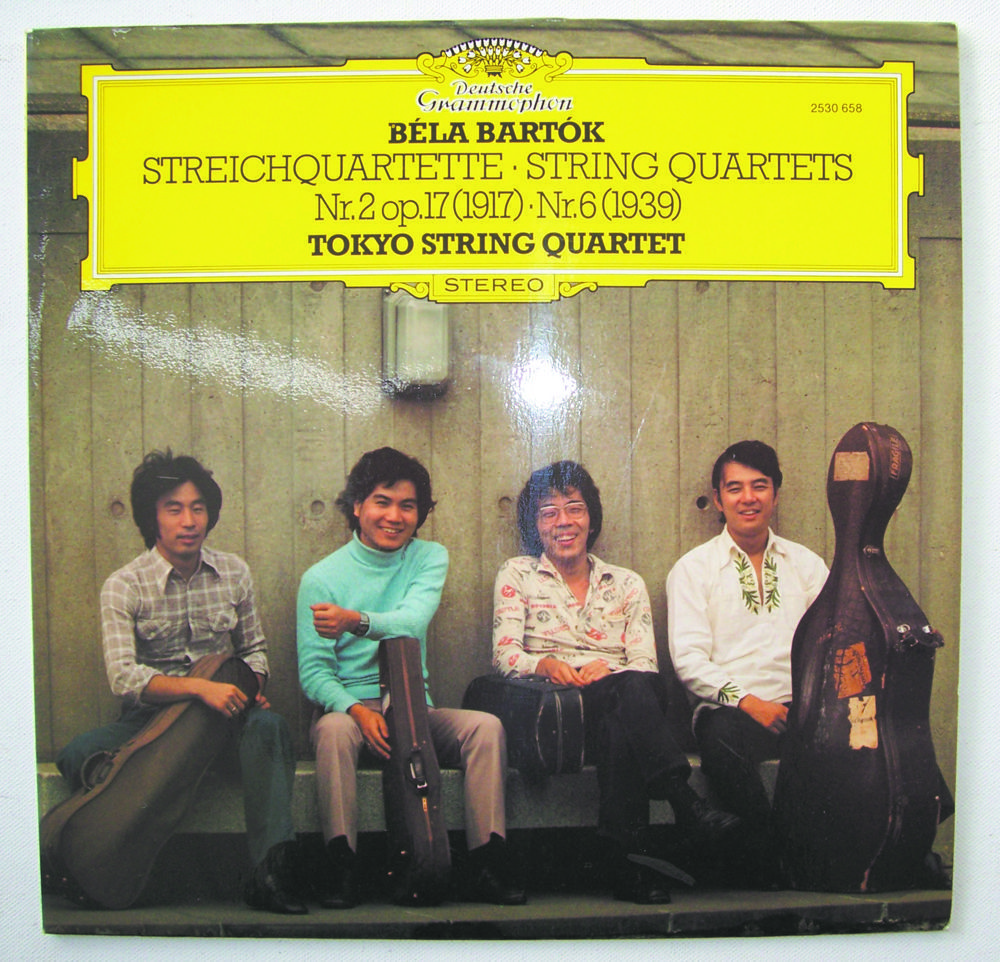 The Tokyo String Quartet’s website tokyoquartet.com contains a list of their more recent, readily available recordings. Most of the quartet’s older recordings are now hard to get and some have never been released on CD. But the Tokyo has made over 40 recordings, including two complete Beethoven cycles, a Bartók cycle, and Takemitsu’s A Way A Lone. Their latest recording, the Piano Quintet and the Clarinet Quintet of Brahms, with Jon Nakamatsu and Jon Manasse, is the second they have made of each of these works. Still to be released is a disc of works by Dvořák and Sme-tana. I’m hoping that videos and live recordings of some of their concerts will eventually appear as well, especially to document some of the many works commissioned by or for them, including Canadian composer Jeffrey Ryan’s String Quartet No.4: Inspirare (2011), Russian composer Lera Auerbach’s Primordial Light and, written for their final tour, her Farewell Quartet.
Pamela Margles is a Toronto-based journalist and frequent contributor to The WholeNote.