

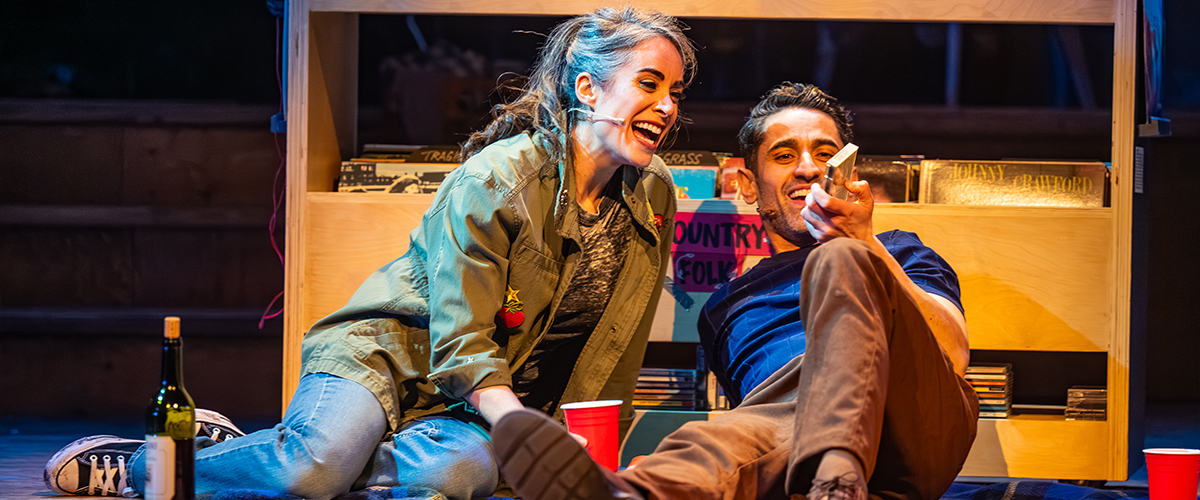
 The “jukebox musical,” for those not familiar with the term, builds a story around the music of some iconic band or artist. – Abba’s music in Mamma Mia, for example. So when I first found out that a new musical, soon to receive its world premiere, was being built around the songs of iconic Canadian band The Tragically Hip, I knew I had to know more.
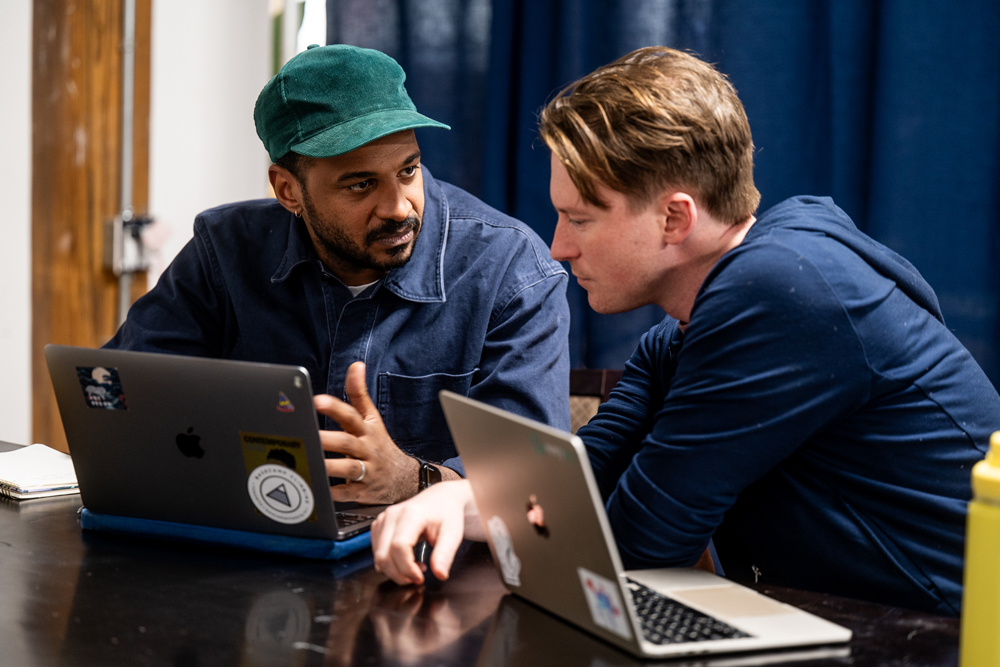
I reached out to the book writing team of actor/writers Ahmed Moneka and Jesse LaVercombe whom I had met a couple of years previously, following the premiere of their King Gilgamesh and the Man of the Wild (created with director Seth Bockley), in which they also starred.
They arrived in the Zoom “room” out of breath and excited, during a rehearsal lunch break where they had found themselves “roped into an intense, high stakes conversation following the morning rehearsal with characters living and dying, songs getting taken out” and more. “Sounds intense”, I observed. “No, it’s the opposite. It’s amazing, but we are getting close and have to make everything marinate and connect.”
Story first
Based on an original idea from the fertile mind of Canadian producer Michael Rubinoff (Come From Away), It’s a Good Life If You Don’t Weaken subverts the typical jukebox musical formula, in the sense that, rather than the story serving the band’s music, here a selection of the Hip’s songs are being chosen to powerfully serve a story – in this case the story of an immigrant coming to Canada and finding a new home.
The protagonist, Waleed, is a well-known journalist in Baghdad, Iraq, in 2002, in the lead-up to the war in Saddam Hussein’s Iraq. Waleed does a frank live interview with the BBC that has consequences. “It’s the cannon explosion that sends him away from his home, unsure of where he is going to land in the world at all,” says LaVercombe. Randomly or through fate, he ends up in Canada, in Kingston, meets Kate, who owns a record store, and the real story begins. “It’s a love story, a story about finding home. They are two people who didn’t expect to meet, who have little in common, who then find common ground.”
“We’re pushing the form in terms of ‘is it jukebox, or is it not’. It lives somewhere in its own space,” LaVercombe told me. “I feel very proud that we as a team are carving that new space, and it’s 90% holding! We all have our different perspectives and ideas that we bring, but we are all sharing the same ‘North Star’: the whole team – cast, creatives, the theatre. We are pinching ourselves all the time. ”
North Star? Moneka explains: “ One, it’s an immigrant story; two, it’s the story of the Hip’s music. So it has something huge to do with Canada, with the way we look at ourselves nationwide, and how the band’s legacy has helped us see ourselves as Canadians. And by placing an immigrant at the heart of the story, we get to look at these concepts through the eyes of a ‘fish out of water’ newcomer. And another part of the ‘North Star’ idea is that the story is about a family looking for somewhere to grow, and the specifics of their journey — what was it like to be in Kingston (Ontario) at that time?”
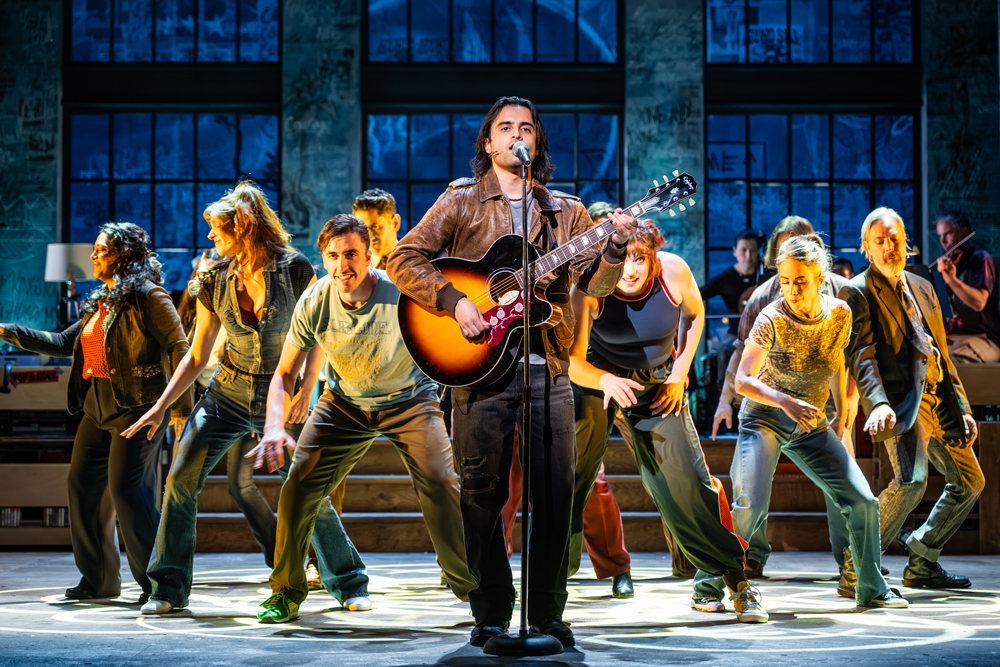
Both writers say the energy in the rehearsal room from every member of the team is “contagious, it is so real and honest. There are tears, there’s laughter, there’s deep discussion and growth from every department, and generosity, and that has a lot to say about Mary Francis Moore, the director, and how she is leading the room.”
“We’ve talked a lot about how we want the specifics of the story to lead to the universal, so we are specific about Canada and Canadian culture and about Iraq and Iraqi culture,” LaVercombe says. “Our hope is that through that specificity, this becomes a universal story of finding and building a new home and what it means to do that, so that audiences anywhere can see this show and see themselves.”
The “jukebox” – the Hip’s music – in this view becomes part of the show’s unique interior theatrical language. What began on the page has grown immeasurably in the rehearsal space: discoveries made as lines are spoken out loud, songs are sung, and blocking and choreography experimented with. “We have an amazing creative team and company, who have such great skills and experience,” Moneka says. “The intellectual heart and mind connection to the material (spoken and sung) is making us dream really big. We wrote [our book] on the page, but now we’re ‘writing the space’, responding to what we hear and see.”
“There are so many rules in the building of a show,” LaVercombe adds, “and we are finding ‘unique to this show’ answers. [By coming] out of the first week with a new version of Act One, we built a group vocabulary that we now all understand, although we are still learning about it.” “It’s so much better when you can hear and see it, and you feel it instead of just reading it!” Moneka adds.
It’s a day-by-day journey of discovery. An example: “In terms of structure,” says LaVercombe, “we’ve discovered that in a two-act show, Act One has to be exciting, but it must also set up the story. It’s the bow drawing back, and then Act Two is like letting it go …. in Act One, there are shorter scenes, and more pieces of songs, whereas in Act Two, both the scenes and songs are longer.”
The playlist
Choosing which songs has been complex. The title song and “Courage” were earmarked from the beginning, even before the writers were on board. Choosing the rest has been with input from the creative team — especially in the early developmental stages from music director and arranger Bob Foster. especially in the early stages as the story was developed.
“At the very beginning of the process,” Moneka says, “the first thing Jesse [LaVercombe] did was to create a playlist that we then listened to constantly.” Live recordings of the band also made a big difference. “Gord Downie, God bless his soul,” Moneka enthused “offers monologue after monologue before every song, and they give you the context and so much more.”
Digging deep into the lyrics was also helpful, as was the documentary by Gord’s brother Mike Downie. “We then also went to Kingston and made a vision board so we could visualize the landscape and soundscape of the show to figure out more tangibly which songs could be there and which couldn’t. The rhythm, the intensity, the release etc. were all part of that process.”
“There were a handful of songs that we knew at the start were going to be in it and maybe some that were on the edge,” LaVercombe adds. “We have our own choices that we’re hanging on to but also we’re trying to hold space and keep organized for all the different ideas that come in. As far as the song list goes, the big songs are the ones that most people would expect and some are gut choices along the way that felt right for specific moments in the show.”
Green light
As for The Tragically Hip themselves, they gave the creators the green light to choose what would work, and since then haven’t been a part of the process at all (though all concerned hope they will see the show when it is up and running). In Moneka’s words, “They are legends, but also Canadian. As a new Canadian, I learned from them to be humble! I asked them questions – like ‘what do you think if we change the music’ and ‘what if this becomes like this?’ for example – and they said ‘It’s nice to see your kid growing and being shaped in different ways’. Rob [Baker], their lead guitarist, asked one of the others ‘What if Gord was here?’ and the others were like ‘Oh, Gord would love this stuff!’”
My last question was what they would say about the show to people thinking of coming – die-hard fans of The Tragically Hip on the one hand, and those who don’t know the Hip songs at all, on the other.
They answered me in unison: “We got you! We got you both!”
It’s a Good Life If You Don’t Weaken, with music by the Tragically Hip, runs from April 22 - May 17 at Theatre Aquarius in Hamilton, and October 22 - November 8 at Thousand Island Playhouse.
Quick Picks
The creation and manipulation of theatrical language is front and centre in several offerings this May and June.
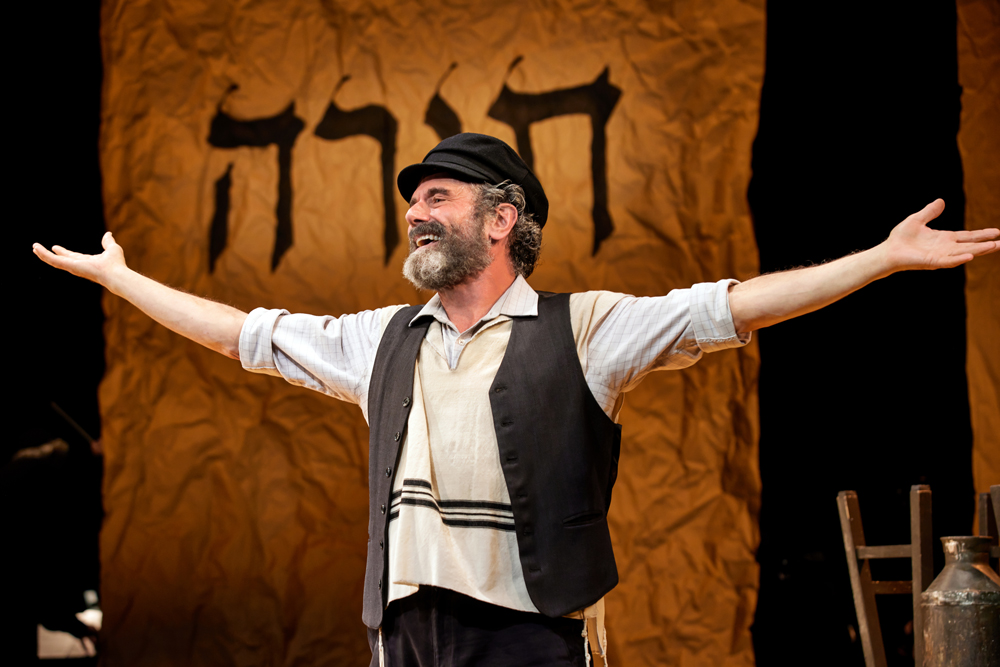
Toronto’s Harold Green Jewish Theatreis presenting an all-Canadian cast version of the award-winning National Yiddish Theatre Folksbiene production of Fiddler on the Roof in Yiddish, first directed by Joel Grey in New York in 2018. Although the classic Bock and Harnick musical was originally written in English, reviews of the NYC production celebrated the added historical authenticity given by hearing the story performed in Yiddish (there are English surtitles). Steven Skybell as Tevye from the original NYC production will lead the cast featuring such homegrown stars as Tracey Michailidis, George Masswohl, Gabi Epstein and Theresa Tova. May 25-June 7 at the Elgin Wintergarden Theatre.
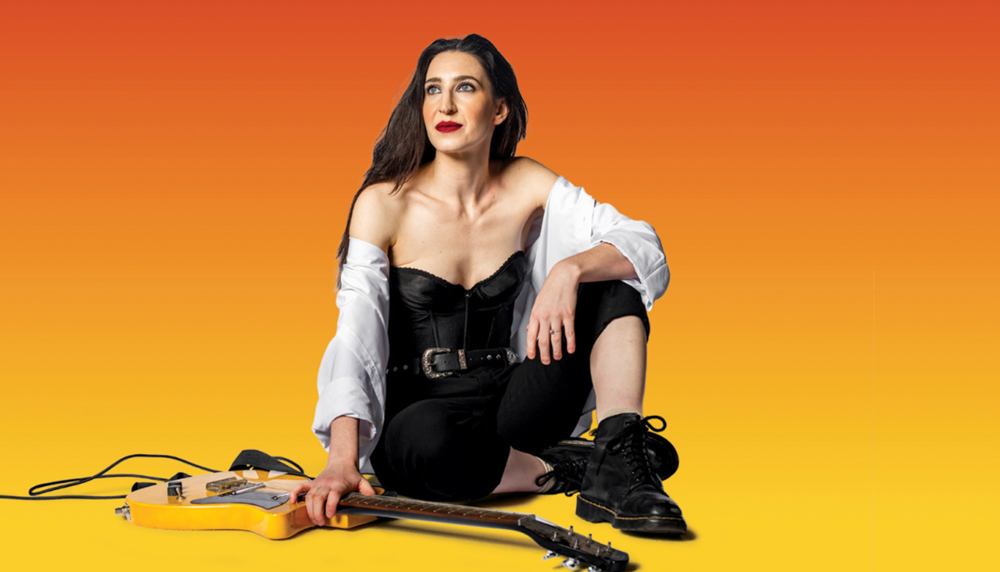
During the Canadian Festival of New Musicals, June 6 and 7, presented by the Musical Stage Company with Luminato and Soulpepper, four creative teams will be showcasing their unique experiments in musical theatrical language with workshop readings, alongside industry panels. Added bonus: the world premiere of Tiger Bride, adapted to music by Frank Cox-O’Connell, Hailey Gillis, and Andrew Penner, based on Angela Carter’s story of the same name and starring Gillis.

Over at the Shaw Festival, previews began on April 24 of a new production of Funny Girl, directed by Eda Holmes and starring veteran stage and musical star Sara Farb, who I’m sure will find her own unique take on the iconic role of Fanny Brice so stamped in the public mind with the personality of Barbra Streisand. April 24 - October 3.
Jennifer Parr is a Toronto-based director, dramaturg, fight director and acting coach, brought up from a young age on a rich mix of musicals, Shakespeare and new Canadian plays.

