04 Wainwright Dream RequiemRufus Wainwright - Dream Requiem
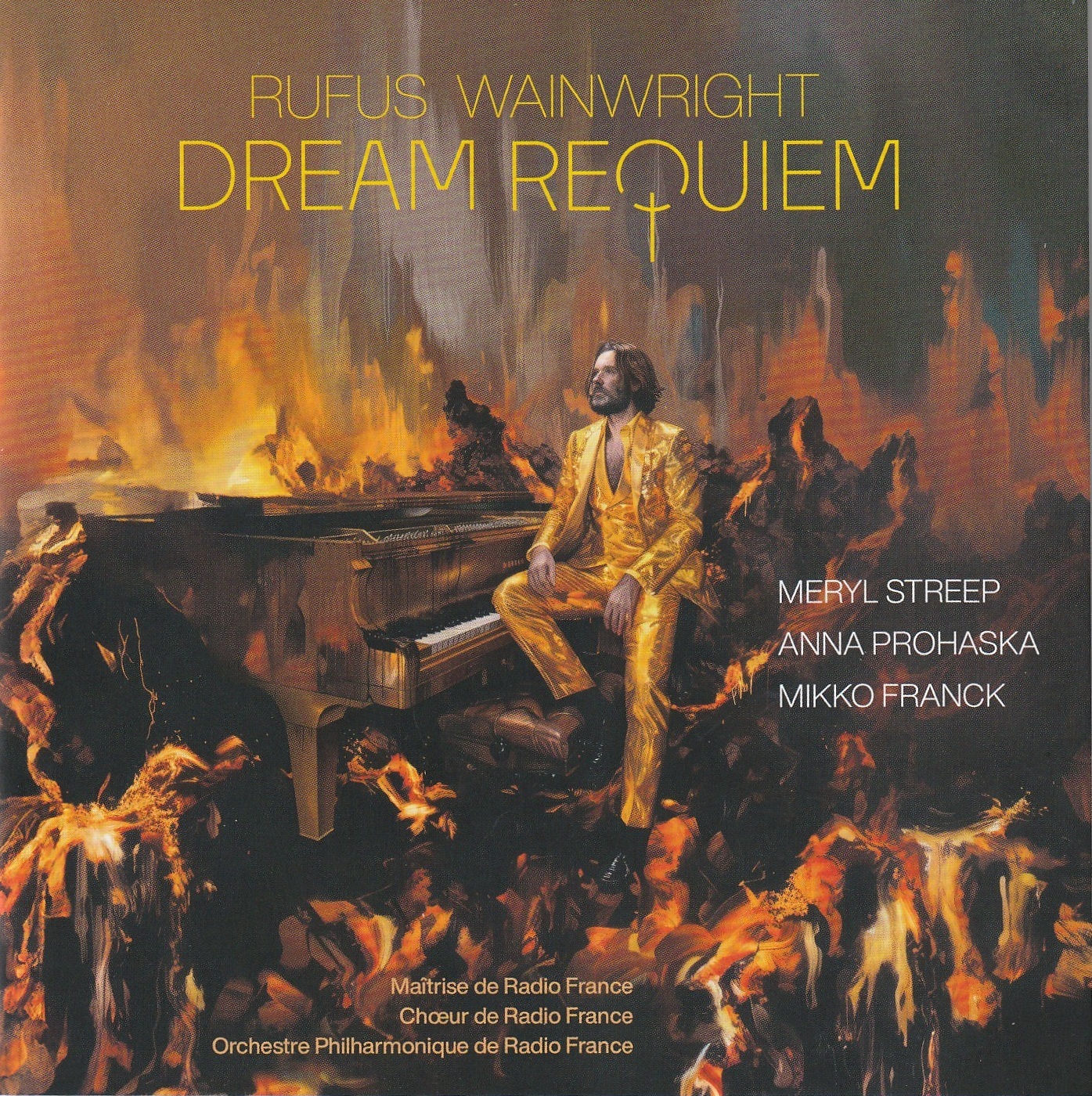
Meryl Streep; Anna Prohaska; Maitrise, Choeur and Orchestre Philharmonique di Radio France; Mikko Franck
Warner Classics 5021732500601 (warnerclassics.com/release/dream-requiem-rufus-wainwright)

Rufus Wainwright’s Dream Requiem was surely made for this moment – even though the Canadian composer, pop songwriter and singer wrote it during the throes of COVID. We feel a sense of foreboding right from the beginning, when the narrator tells us, "I had a dream, which was not all a dream.” With that, we are plunged into the nightmare of Lord Byron’s aptly named poem, Darkness

A Requiem deals with loss. Yet what’s described is total annihilation. Wainwright artfully transcends the utter devastation by layering sections of the Latin Mass for the Dead into Byron’s apocalyptic poem. Hope comes in the final section, the In Paradisum, when the sublime children’s choir offers the consolations of eternal rest.  

Wainwright’s musical language here is not the most daring. But it is imaginative, personal, and highly expressive. Sumptuous melodies, catchy rhythms, rich harmonies – all inescapably Wainwright’s.

Conductor Mikko Franck calibrates the huge forces for both expressiveness and clarity. Soprano Anna Prohaska soars with the exquisite presence of a divine spirit, while the dramatically charged choir honours Wainwright’s deep connection to the words. 

Actor Meryl Streep catches every nuance in Byron’s text. Her sober narration reins in Wainwright’s heart-on-sleeve romanticism – that is, until the Dies Irae. Streep, as the voice of retribution, tears through it in a frenetic, virtuosic tour de force.  

Wainwright is undoubtedly better known for his singing and songwriting than his classical compositions. But Dream Requiem should be heard.

05 Hannigan Electric FieldsElectric Fields
Barbara Hannigan; Kati and Marielle Labeque; David Chalmin
Alpha Classics ALPHA 980 (outhere-music.com/en/albums/electric-fields)

By now my editor knows full well just how mesmerised I am by Barbara Hannigan. How – in my eyes – she can do no wrong. He also knows that if there is a new Hannigan recording – as sure as day follows night – I will make a beeline for it and likely find no fault in it whatsoever. The reason? There will be no fault with a Hannigan recording. That’s just the way it is. 

Let’s put aside Hannigan’s prowess as an actor and conductor for now. As an operatic star she is a once-in-a-lifetime kind of artist who does everything right, by any composer, in any repertoire from any era. This is how things go on Electric Fields (or might I say, “eclectic fields”?).

Her soprano instrument is lustrous throughout, whether she is interpreting Hildegard von Bingen (c.1098-1179) – O virga mediatrix and O vis aetrnitatis – or Barbara Strozzi (1619-1977) – Che si può fare – or two works by Bryce Dessner (b.1976). Hannigan also contributes one composition – Che t’ho fatt’io based on a fragment of Latin texts by Francesca Caccini (1587-c.1640).

Admittedly Hannigan shines alongside such star power as the piano-playing heavyweights, Katia and Marielle Labèque, and the wizardry of composer/performer David Chalmin’s ambient atmospheric contributions. But Hannigan’s performance is flawless – again. Each work is a priceless sound-painting. Each phrase has its own tinta; each vocal section a distinctive character. It’s exciting to wonder what comes next. One can only dream.

06 Christopher Tyler NickelChristopher Tyler Nickel - Mass; Te Deum
Catherine Redding; Vancouver Chamber Choir; Vancouver Contemporary Orchestra; Clyde Mitchell
Avie Records AV2748 (avie-records.com/releases/christopher-tyler-nickel-mass-•-te-deum)

“Beauty-filled music” – that’s what I called Christopher Tyler Nickel’s Requiem (The WholeNote, Summer 2024), praising Nickel’s “distinctive melodic gift” that consolidated influences from Gregorian Chant to Bruckner, Fauré and Carl Orff. Along with his many scores for film, theatre and TV, the B.C.-based Nickel continues his commitment to sacred texts with Mass and Te Deum, composed concurrently between 2019 and 2024. Around 26 minutes each, they’re modest in scale compared to the 70-minute Requiem and minuscule measured against his seven-hour setting of The Gospel According to Mark.

“I’m always finding the melancholy in things,” writes Nickel. Here, his unusual scoring combines, in addition to strings, the plaintiveness of oboe, English horn, oboe d’amore and bass oboe with the sepulchral sonorities of four horns and tuba in Te Deum, two Wagner tubas replacing two of the horns in Mass. The pervading disquiet is heightened by continually shifting, irregular meters, including measures of five, seven and ten beats.

Nickel supplants Requiem’s stylistic eclecticism with a hyper-emotional, near-cinematic spin on Renaissance modes and harmonies. Mass begins with a plea of desperation in Kyrie, followed by a joyous Gloria, but solemnity reigns throughout the remaining sections. Te Deum is even darker. Canadian soprano, Catherine Redding, soloist in the Requiem recording, adds fervent entreaties to Te Deum’s intense anguish. Clyde Mitchell, conductor of the Requiem CD, draws urgent drama from Vancouver’s Chamber Choir and Contemporary Orchestra in these latest examples of Nickel’s truly “beauty-filled music.” 

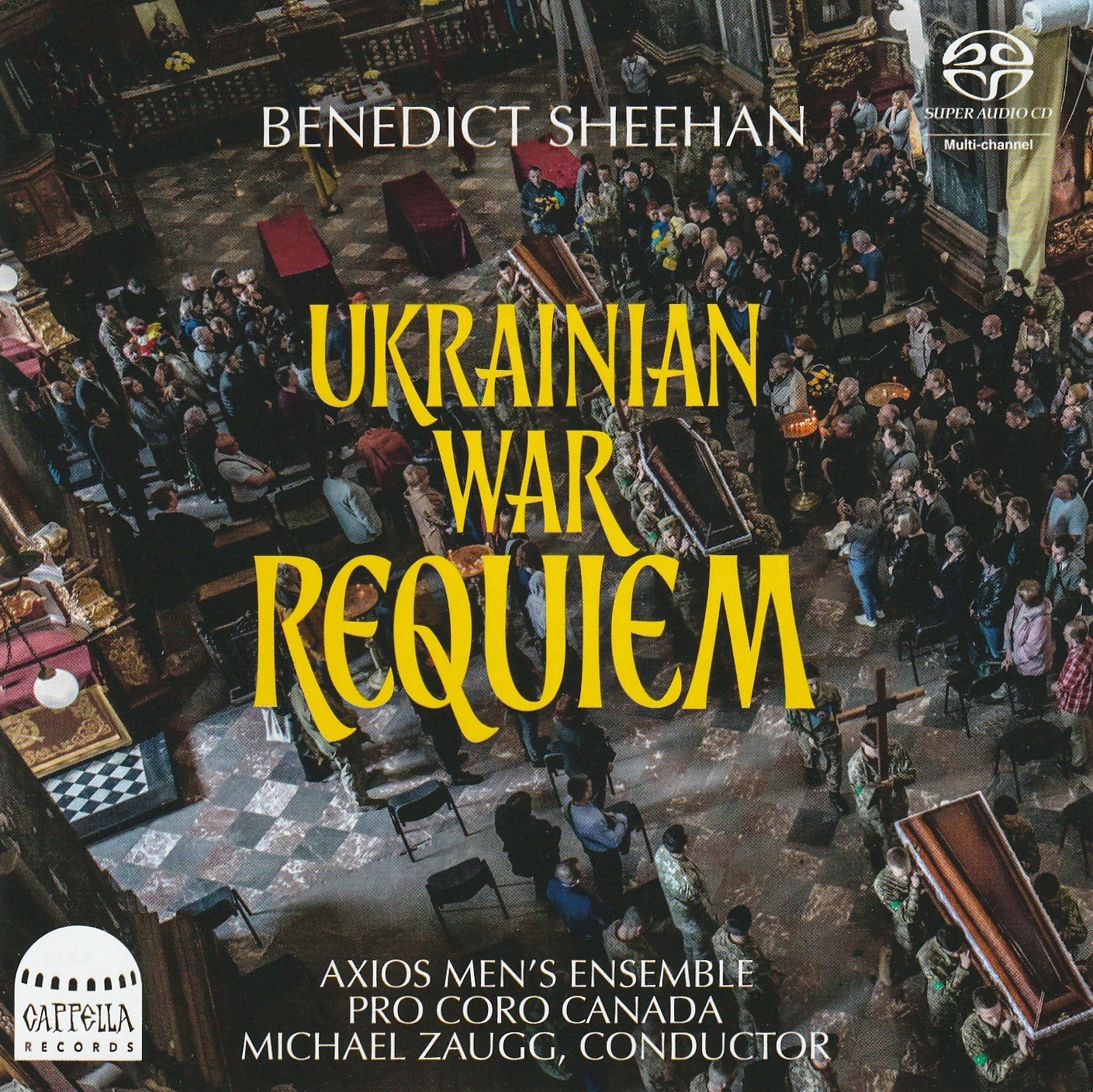
07 Ukrainian War RequiemBenedict Sheehan - Ukrainian War Requiem
Axios Men's Ensemble; Pro Coro Canada; Michael Zaugg
Cappella Records CR432 SACD (axioschoir.com)

After Russia invaded Ukraine in February, 2022 American Benedict Sheehan received a commission from Edmonton’s Axios Men’s Ensemble, performers of Eastern European sacred music, many of its singers sharing Ukrainian roots. Sheehan was asked, he writes, for “a new composition in honor of those fallen in Ukraine’s struggle for freedom.”

Sheehan’s Ukrainian War Requiem was premiered in Edmonton on April 14, 2024 with the Axios Men’s Ensemble and the tenors and basses of Edmonton’s Pro Coro Canada conducted by Pro Coro’s artistic director, Swiss-born Michael Zaugg.

In keeping with Ukraine’s mixed religious heritage – Orthodox, Catholic and Jewish – Sheehan drew texts from the Ukrainian Memorial Service, hymns of St. John of Damascus, Psalms 50 and 90, the New Testament Gospels and the Latin Requiem Mass. He combined, he says, “a variety of musical influences, including Ukrainian and Galician plainchant (somoilka), Gregorian chant, a Ukrainian Jewish psalm tone (nusach) and an array of original melodies,” as well as Shche Ne Vmerla Ukraïna (Ukraine Has Not Yet Perished), Ukraine’s national anthem.

Throughout the work’s 67 minutes, the richly sonorous men’s chorus sings with fervent urgency in Ukrainian, Latin and English, several choristers contributing solos; the major solos are sung by Ukrainian soprano Yuliia Kasimova and Canadian tenor John Tessier. Based on traditional church modes, Sheehan’s powerful, often heart-rendingly beautiful score is a loving tribute to the Ukrainian dead that deserves to be heard everywhere in remembrance of all victims of all wars.

08 O ListenO Listen to the music of Uros Krek & Else Marie Pade
Danish National Vocal Ensemble; Marina Batic
Our Recordings 8.226924 (ourrecordings.com/albums/o-listen)

This is the ninth release in a series of challenging projects from the Danish National Vocal Ensemble on Our Records. The professional chamber choir scene, especially amongst the Nordic countries, including Canada, is one of the most musically fecund departments in contemporary music. Choirs just seem to be getting better and more capable of negotiating ever newer compositional demands.

The retro graphic on the cover, a clunky ear, suggests that this release is odd. The disc opts to investigate some out-of-the-way developments around the middle of the 20th century. The Slovenian conductor of this ensemble, Martina Batič, has chosen two rarely exposed composers, one a fellow Slovenian, Uroš Krek, and Danish music concrète practitioner Else Maria Pade. 

Krek has a mid-century choral style that is closest to Gerald Finzi in the three English language pieces included, but the subsequent pieces in Slovenian and Latin show several attractive elements of his very solid style.

Pade’s mellifluous style fits well with standard mid-century practices, although she never sounds English. The real curate’s egg on this disc is one of Pade's electronic projects, an immersive environment meant to go around a challenging stratospheric coloratura soprano, baritone, speaking (like zombies) chorus and seven trombones. The electronic background includes assembled sounds. The very brief trombone chords and notes really make this piece. 

Performances throughout the recording are all supremely beautiful.

Listen to 'O Listen' Now in the Listening Room

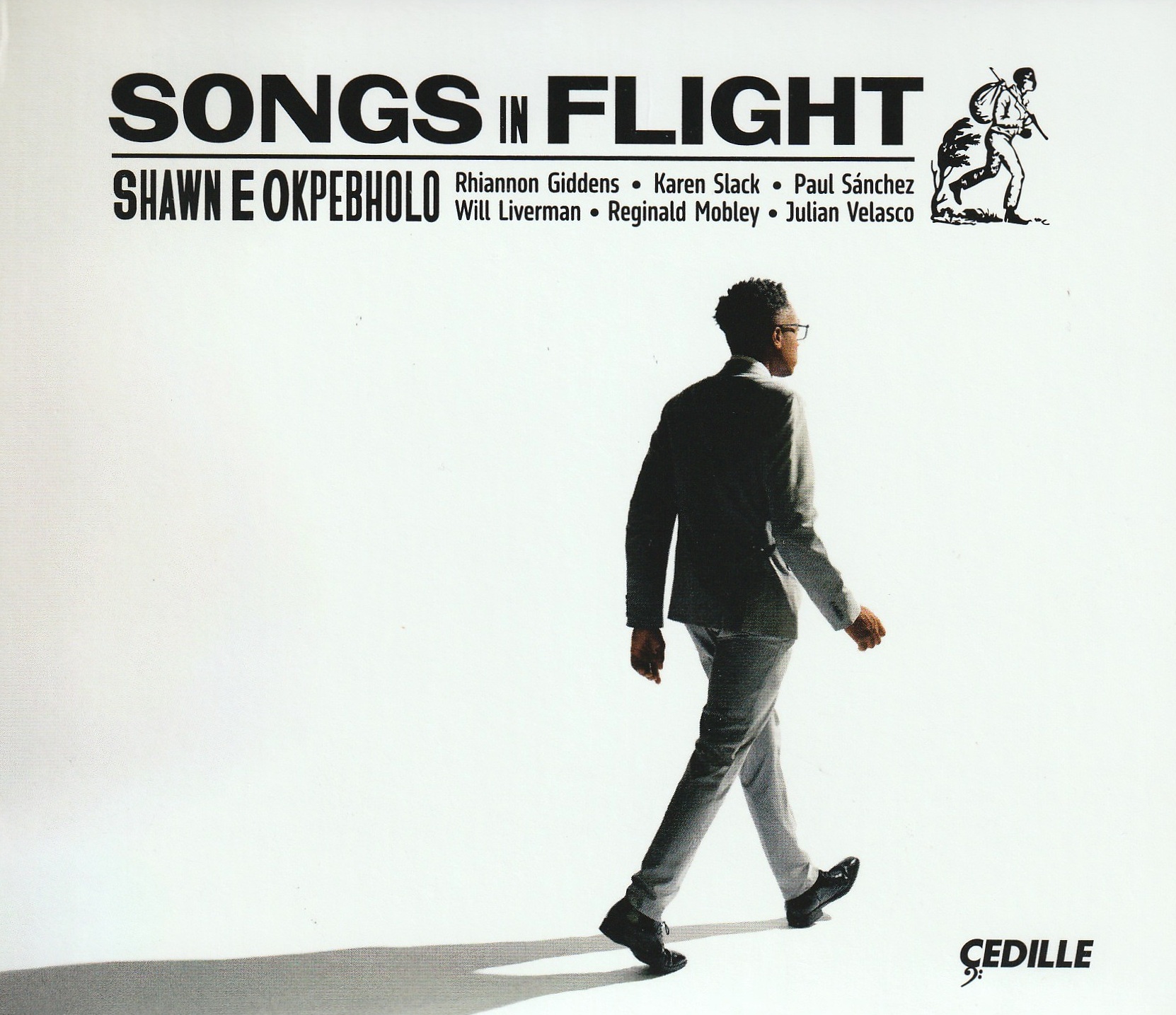
09 Songs in FlightShawn E Okpedholo - Songs in Flight
Rhiannon Giddens; Karen Slack; Paul Sanchez; Will Liverman; Reginald Mobley; Julian Velasco
Cedille Records CDR 90000 234 (cedillerecords.org/albums/songs-in-flight)

Shawn E. Okpebholo’s exquisite disc Songs in Flight, strikes me as being an incredibly beautiful – and disturbing – new palimpsest of the American Spiritual. The uncomfortable truth of each song cuts to the quick, deep within the heart. 

Okpebholo's songs repurpose news stories of young boys and girls escaping slavery during the 18th and 19th centuries using the language of poetry. His music turns the narratives into arias sung by lyric soprano Rhiannon Giddens, mezzo Karen Slack, baritone Will Liverman and renowned countertenor Reginald Mobley. Paul Sánchez’s pianism and a forlorn saxophone accentuate the dark atmosphere.

Missing may be the story of Emmett Till, but spirituals about Ahmaud Arbery and Trayvon Martin tell their tragic stories with fervour and operatic flair. In particular the lynching of Arbery is a painful gut-punch and even complements Sing, O Black Mother by Langston Hughes. 

Slavery has deep roots, its history spanning diverse cultures and geographical regions. But the transatlantic slave trade and its institutionalization on plantations has had a profound and enduring impact on the history of the US, leaving an indelible legacy of racial injustice and inequality that continues to resonate today. 

“I said your name / first, choked in wondrous / love. Nothing more holy / than the first farewell. My womb, no longer / habitable. My song / was your first and only home.” – words by Wanda-Cooper Jones, Arbery’s mother on Ahmaud sung by Giddens, send a chill through the spine.

01 Handel Nine German AriasHandel – Nine German Arias
Nicole Palmer; Marika Holmqvist; Rebecca Humphrey; Barbara Weiss
Zenith Ensemble (zenithensemble.org)

Of Georg Frideric Handel it is believed – and certainly true – that of his contemporaries, only J.S. Bach produced work in which such qualities of robustness, lucidity and passion were so delicately balanced. These Nine German Arias, an exposition of rarely performed gems by baroque Zenith Ensemble - Nacole Palmer co-artistic director and soprano, Markia Holmqvist baroque violin, Rebecca Humphrey baroque cello, Barbara Weiss harpsichord - are an indisputable testament to this fact.

With immaculate consistency of sound and approach the Zenith Ensemble makes a more than fitting and generous celebration of this repertoire, confirming the organization’s high achievement of this period work. These are live-wire performances, technically excellent and propelled with exactly the right degree of eloquence and driving energy by Palmer. Her Handelian qualities are superbly showcased.

Palmer’s interpretations combine great imagination and musicality with a special ability to find details in the music that you maybe hadn’t registered before. Magically, she draws them out and thrills you with them. In Den Angenedmen Büschen and Süsser Blumen Ambraflocken are but two outstanding examples. 

I must leave room to laud the instrumental performers. They make things easier for Palmer. Bright but strong in tone, virtuoso but pressingly expressive, Holmqvist, Humphrey and Weiss display just enough distinctiveness that can touch the heart by revealing there are three other persons to Zenith, not just Palmer’s superb voice.

02 Forgotten SpringForgotten Spring – The Early Lieder of Fanny Hensel
Harry Baechtel; Chuck Dillard
Acis APL53882 (acisproductions.com/forgotten-spring-fanny-hensel-lieder-harry-baechtel-chuck-dillard)

A quarter of a century into our next millennium we are in the thrall of remarkable discovery, that of incredible music by women composers. These works include buried masterpieces by composers such as Clara Schumann, Florence Price – and most remarkable of all – hidden gems by the brilliant Fanny Mendelssohn Hensel.

Some of Hensel’s work has been performed and recorded (and reviewed here too). And now we have a disc of some of her most remarkable work. In fact, The Early Lieder of Fanny Hensel, displays a genius akin to her illustrious brother Felix.

Listening to this recording is a heady experience. It almost feels as if no expression would be hyperbole enough to express admiration for Hensel’s lieder. Her maturity – rare erudition with regard to the poetics of lied, sensitivity to lyric and finding the absolute perfectly suited melodic and harmonic conception to employ – is breathtaking. 

The extraordinary music interprets poems by Johann Peter Eckermann who lived in the long shadow of Goethe. Among other poets represented are works by Luise Hensel, Ludwig Tieck, Johann Henrich Voß and Sir Walter Scott.  

Meanwhile the deep and resonant baritone of Harry Baechtel captures the textural luminosity distilled into wondrous music. Moreover, the delicate pianism of Chuck Dillard makes for a perfect musical partnership.

Listen to 'Forgotten Spring: The Early Lieder of Fanny Hensel' Now in the Listening Room

03 Cohen Steal a PencilGerald Cohen – Steal a Pencil for Me
Opera Colorado; Ari Pelto
Sono Luminus SLE-20034 (sonoluminus.com/sonoluminus/steal-a-pencil-for-me?rq=pencil)

The evil Nazi era of the 30s and 40s stole more than six million lives. But that Holocaust during World War II held many miracles in secret. One of these unfolds on this exquisite double-disc, in a deeply expressive opera with short solo and duet arias and powerful recitatives, which goes like a bolted arrow directly to the heart.

Steal a Pencil for Me, by composer Gerald Cohen and librettist Deborah Brevoort, is a story of joy, hope and the imperative to survive in tender, requited eternal love (mixed in with elemental sadness and despair). Let’s also not forget a magnificent cast of opera stars playing principal characters and the cast of supporting artists together part of Opera Colorado, expertly shepherded by the conductor Ari Pelto.

Based on the book of the same name, the narrative is a quadrangular love story: among principal Jaap Polak (played with lyrical tenderness and strength by baritone Gidean Dabi) and his deeply empathetic wife Manja (brilliant Adriana Zabala), Jaap’s true love Ina Soap (the liquid soprano Inna Dukach) and her fiancé Rudi Cohen (the sublime, dramatic Daniel McGrew). Other roles are superbly played and include friends and family, three Nazis, and a chorus of nine with chorusmaster Sahar Nouri, who is also a pianist in the orchestra.

Act 1 telling of persecution in Amsterdam and the unfolding of the love story in Westerbork is brought to dramatic life. Act 2 depicts survival in Bergen-Belsen, a secret Passover celebration, lovers lost and reunited in a happy conclusion back in Amsterdam. The package includes booklet essays, Brevoort’s libretto driven by excellent cultural anthropology. Cohen’s vent is dramatic and dark, and atmospherically sinister. And operatically grand. The tenderness of the dénouement after short, outstanding operatic arias and recitatives is sustained throughout making for a memorable event.

Back to top