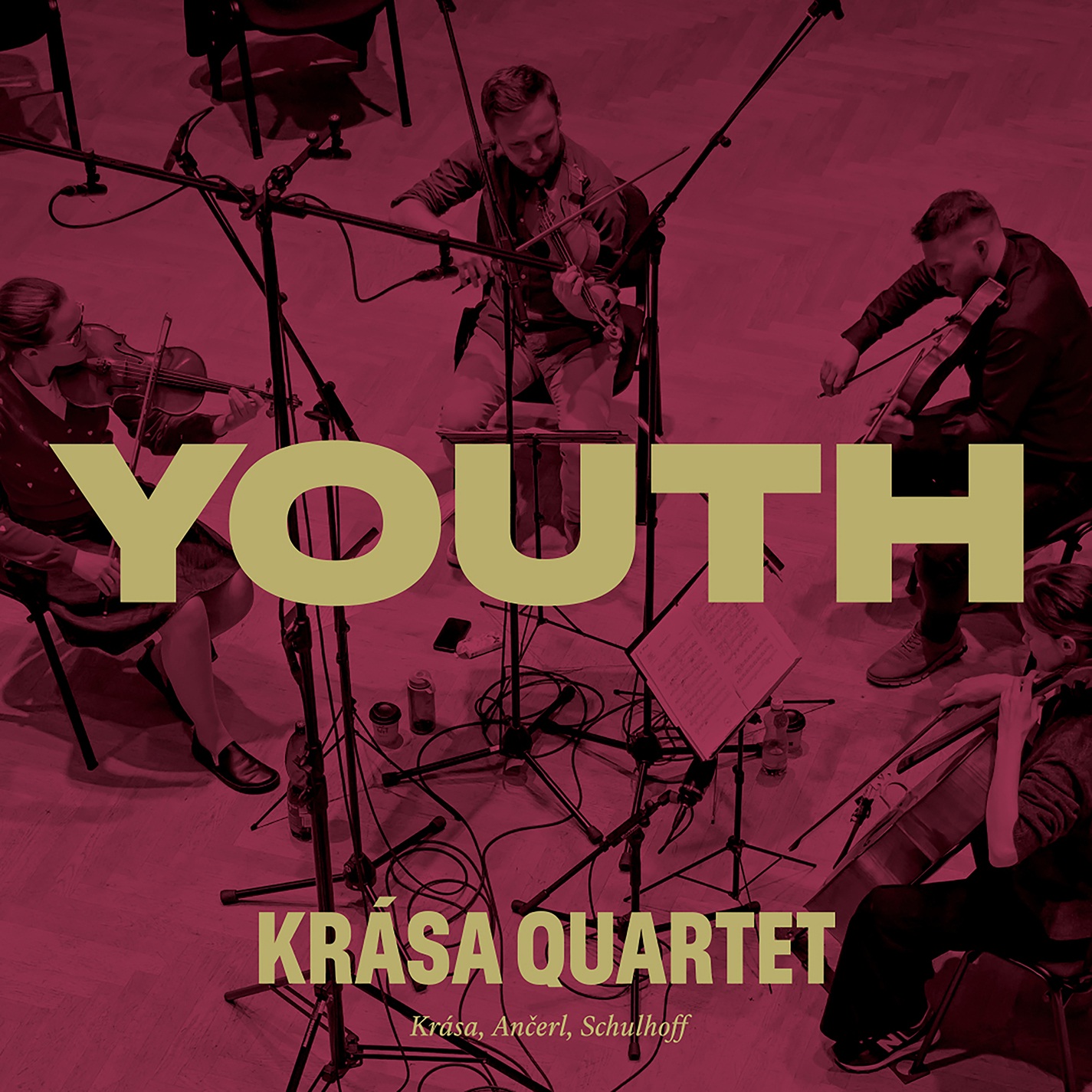
 Youth – Krása | Ancerl | Schulhoff
Krása Quartet
Supraphon ANI-145-2 (wearewarpedrecords.com/UPC/8594211850674)
The Prague-based Krása Quartet’s debut album honours three Czech-Jewish victims of the Nazis, including Hans Krása (1899-1944), the ensemble’s inspiration, who was murdered in Auschwitz. Influenced by Zemlinsky and Mahler, Krása’s early String Quartet, Op.2 (1921) mixes lyricism, harmonic instability and highly imaginative part-writing, juxtaposing sonorities from the violin’s highest register to the cello’s lowest. The opening Moderato features brooding, disquieted chromaticism; the whimsically titled Prestissimo-Molto Calmo-Volgare is a fantastical excursion through strident dissonances and kitschy clichés; the predominantly meditative Molto lento e tranqillo is interrupted by an intense, far-from-“tranquil” climax before slowly subsiding into silence. This youthfully audacious work contrasts markedly with Krása’s Theme with Variations (1935-1936) which tries too hard to please with its excessive sentimentality.
Karel Ančerl (1908-1973) survived internment in Auschwitz, albeit with permanently impaired health; his wife and son, however, died there. Ančerl, the Czech Philharmonic’s artistic director (1950-1968), emigrated after the Soviet invasion, becoming the Toronto Symphony’s music director from 1969 until his death. His robust Two Fugues (ca.1926-1927), brief student exercises, suggest Ančerl’s compositional potential before he opted instead for the baton.
Erwin Schulhoff (1894-1942), who died of tuberculosis while interned at Wälzburg, embraced diverse styles including jazz and musical Dadaism – his absurdist, silent piano piece In Futurum, consisting solely of rests, possibly inspired John Cage’s 4’33”. The young Schulhoff’s five-movement Divertimento (1914) alternates cheerful and melancholy folk-flavoured melodies. It’s an appealing work, but the real gem here is Krása’s boldly ingenious String Quartet.