Often thought of as our rough-hewn, republican cousins from down under, Canadians and Australians share a similar history as the best-known outposts of the former British Empire now on our own within the Commonwealth. Situated on their own continent, distant from many other countries, Aussies have arguably had an easier time establishing their own cultural identity not being stuck beside the American behemoth as we are. Australia’s creative scene reveals variations of sounds you’d hear elsewhere as well as those unique to the continent-country, as the following discs prove.
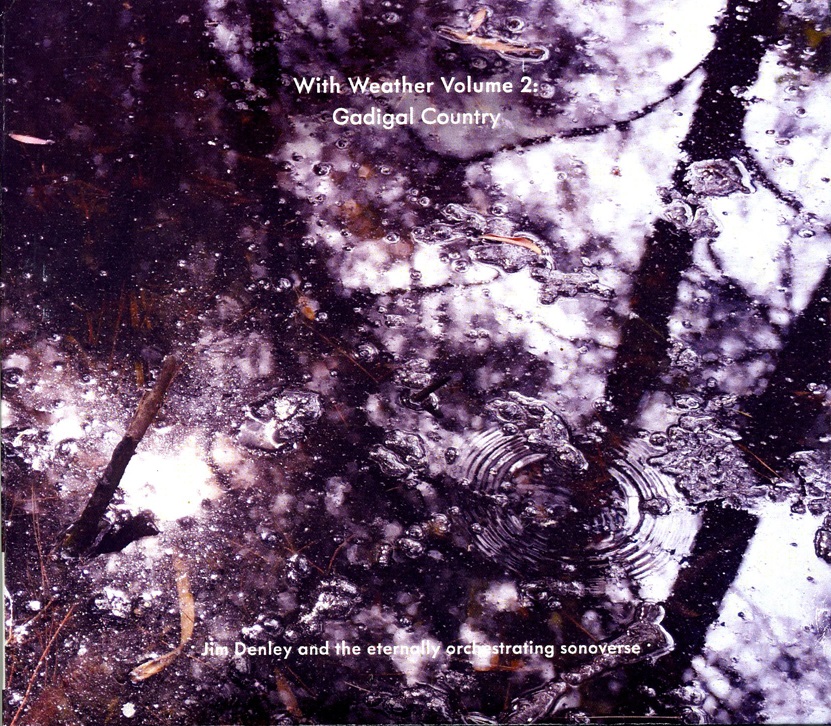
 Probably the most genuinely Australian of this group is With Weather Volume 2: Gadigal Country (Split Rec 32 CD splitrec.bandcamp.com/album/with-weather-volume-2-gadigal-country), part of a recorded musical trilogy by Jim Denley and the Eternity Orchestrating Sonoverse. Recorded in various locations in rural parts of Australia, it features the flute, wooden flute and voice of Denley with the so-called Eternity Orchestrating Sonoverse actually being sonic reproduction using two hard disc recordings of his improvisations in the context of nature’s avian, mammalian, arboreal, amphibian, industrial and elemental sounds. Captured in real time in Gadigal Country, a harbour area just east of the city of Sydney, the two-CD set makes natural sounds the backdrop, partner and contrapuntal motif alongside Denley’s restrained and consistent playing. What that means in essence is that widening hollow puffs, transverse flutters, triple tonguing and circular breathed interludes share aural space with ever-changing rustic and natural occurrences. In this way instrumental and vocal textures are framed by or play alongside the cacophony caused by impending storms, watery gurgles from nearby ponds, lapping waves, children nattering, seagull squawks, cockatoo and other aviary cries, excited dog barks, cricket songs, pelting and dripping rain droplets, distant boat whistles and other Arcadian interruptions. One notable sequence is when a couple of crows nearby decide to add their penetrating caws to Denley’s flute motif leading to a pseudo bird-and-human jam session. Singular itself, With Weather specifically defines the true sound of non-urban Australia.
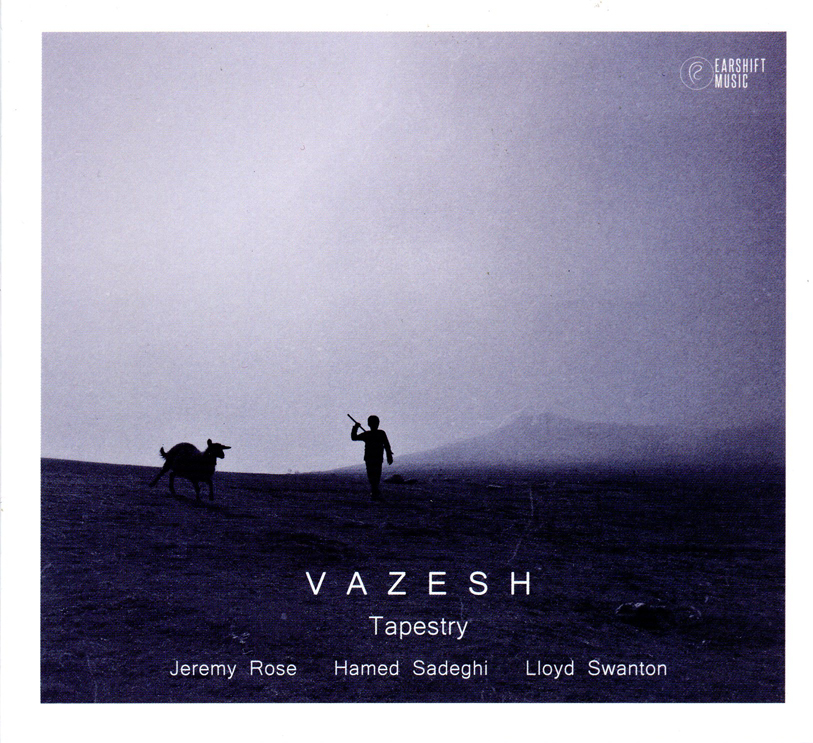
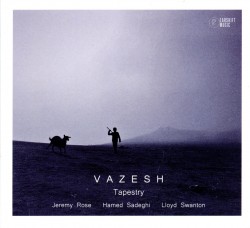 While there’s also plenty of conventional jazz in Oz – as there is in Canada – more meaningful are those musicians in both countries who stretch the form. A fine example of this is Tapestry (Earshift Music EAR 092 vazesh.bandcamp.com/album/tapestry) by the Vazesh trio which unites locals tenor and soprano saxophonist/bass clarinetist Jeremy Rose – who often switches among the horns on single tracks – and bassist Lloyd Swanton, who is also one-third of The Necks, and Iranian-born, Sydney-based Hamed Sadeghi, an adept player of the Persian tar, a long-necked lute with three double courses of strings and 28 adjustable gut frets. On 14 tracks, in length from slightly over two to more than seven minutes, the tunes logically flow one into another almost without pause. Crucially, there are no gaps among the textures of the so-called exotic instrument with the conventional ones during these notable improvisations. Rose’s chalumeau register clarinet slurs, feathery soprano saxophone soars and Swanton’s paced pizzicato strops or sul tasto elaborations, harmonize, contrast or meld with the tar’s deep strums or advanced finger picking. While a track such as Azure includes faint ney-like twitters from Rose, despite being coupled with Sadeghi’s widening strokes, thick double bass stops keep it from becoming Persian music. Additionally while multiple tracks such as Zircon and Calabash for instance feature the tar’s pinched picking and ringing clicks that could come from a banjo, any intimations of Bluegrass or Dixieland are swiftly dispensed by undulating tenor sax tongue stops as Swaton’s arco buzzes create call-and-response interludes joining slurred fingering from the tar. Overall the program takes into account multiple string interaction and a reed output that is alternatingly gritty and glossy. This is storytelling that is as deliberate as it is dashing, and confirms the trio’s strategy when the low pitches of the concluding Saffron harken back to similar basement tones that began the suite.
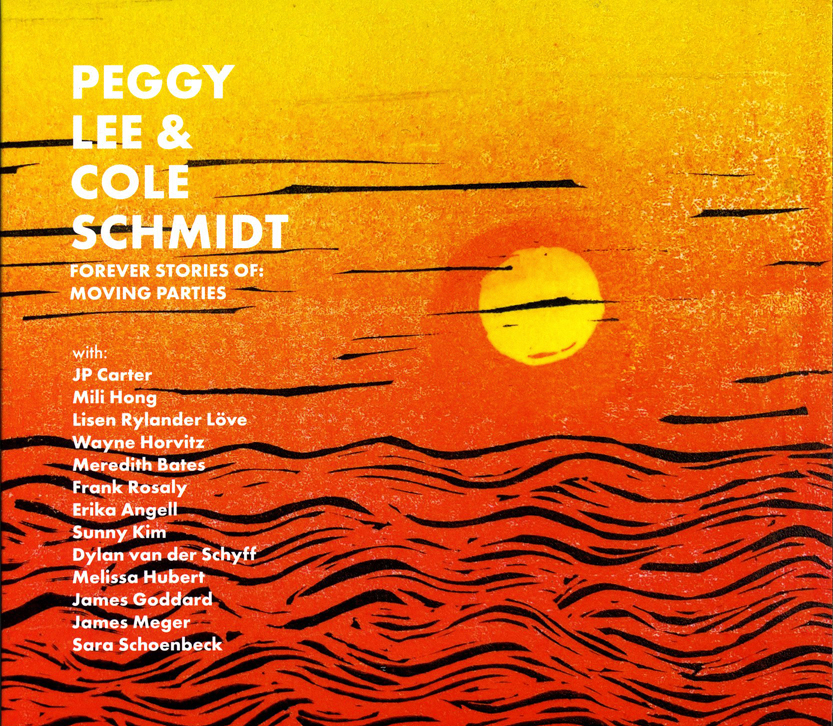
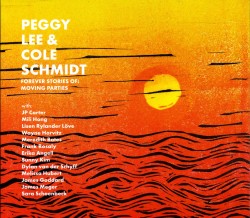 The country’s geographical location doesn’t preclude Australian improvisers from collaborating with sympathetic international players, on home turf, overseas or telematically. For example since Vancouver drummer Dylan van der Schyff is now a professor at the Melbourne Conservatorium of Music, his wife cellist Peggy Lee is a frequent visitor. Not only have the two formed a quartet with local improvisers, but also via the internet are able to collaborate with associates in B.C. and elsewhere. That’s precisely what Forever Stories of Moving Parties (Earshift Music EAR 098 peggyleecoleschmidt.bandcamp.com/album/forever-stories-of-moving-parties) preserves. An outgrowth of the band Lee and Vancouver guitarist Cole Schmidt lead at home, it expands the 14 tracks with affiliated sounds from players in Vancouver, Montreal, Gothenburg, Amsterdam and Melbourne. While there are some understated folksy sequences from the two principals plus locals such as drummer Mili Hong and trumpeter JP Carter, other tracks are more striking. An example is for Ron Miles, where widening tones from Carter and Vancouver violinist Meredith Bates plus Lee and Schmidt are supplemented by van der Schyff’s steady drumming. Van der Schyff also provides the backing on it will come back to intersect with a formal cello sweep and country-styled guitar licks, yet the vocalizing is from Melbourne’s Sunny Kim. More geographically unique is mercy. Synth bass pacing is from Vancouver’s James Meger, crackling electronics from Amsterdam’s Frank Rosaly, with the elevated trumpet and cello harmonies complementing intersecting wordless vocals sung by Montreal’s Erika Angell and Kim. Variations of this multi-continent mix and match are prominent throughout the disc. Yet the electronic wizardry never interferes with the cohesion or flow of the disc. Notwithstanding interjections in some tunes from unexpected sources like Swede Lisen Rylander Löve’s mixture of electronically fractured Nordic chanting and saxophone flutters or Wayne Horvitz’s keyboard pressure, balance in the form of Carter’s linear portamento trumpet, Schmidt’s finger-style comping and glissandi sweeps and stops from Lee, equilibrium is maintained. Instances of rocking out uniting Schmidt’s elevated riffs and Horvitz’s pressurized organ pumps from Vancouver and splash cymbals and drum backbeat from Melbourne via van der Schyff are also taken in stride.
 Homebody Aussies are also members of international ensembles as evidenced by Sydney-based keyboardist Alister Spence. While he leads his own bands and is involved in other collaborations, since 2017 he’s been part of the Kira Kira quartet, which on Kira Kira Live (Alister Spence ASM 015 alisterspence.bandcamp.com/album/kira-kira-live) includes Japanese players trumpeter Natsuki Tamura, pianist Satoko Fujii and drummer Tatsuya Yoshida. Unlike many Tamura/Fujii combos, a good part of this CD’s five tracks focuses on the oscillations created by Spence’s fender Rhodes piano, effect pedals, preparations and percussion. These slippery and shifting dynamics mated with Yoshida’s drum strategies, ranging from cymbal shivers to brawny backbeats, means that Fujii’s acoustic patterns are responsible for the lyrical, formalist and ultimately linear evolution of the sequences. Forthright, the trumpeter’s interpolations include jagged bites, sudden rips, half-valve strains and plunger expositions. Supple or striated interconnections are frequently set up between say drum paradiddles and trumpet riffs or jiggling slaps from the electric keyboard challenged by triplet skyrockets from Tamura. With interludes such as those on Bolognaise where motifs encompass both jittery nonsense syllables vocalized by all, the drummer’s understated swing beat and an antique harpsichord-like interlude from Fujii’s prepared piano jabs, discord is sometimes suggested, but is finally rightened to horizontal progression. More subtle than showy, these textural shifts can involve tempo redefinition with electro-acoustic wriggles, gutbucket brass emphasis and cascading acoustic piano runs. Yet more spectacularly, on the extended Kite, and hovering elsewhere, rappelling or plummeting group sequences usually led by robust Rhodes keyboard dabs settle into a persistent groove cemented by drum pops and trumpet peeps.
 Because of the distances involved, some Aussie musical innovators expatriate permanently when they find a sympathetic situation. That’s the case with Melbourne percussionist Steve Heather who has been based in Berlin since the turn of the century. Part of multiple bands, a notable one is **Y**, whose group Four Star Y (Grammar Phone Records GPHLP 102 danpetersundland.bandcamp.com/album/four-star-y) also includes Norwegian electric bassist Dan Peter Sundland and American synthesizer player Liz Kosack. Sophisticated drone-improv, the six selections include an underlying low-pitch throb, with Kosack using her instrument to also add seeping pipe-organ-like undulations, elevated squeaks and stops, tremolo jabs and celestial-styled signal processing. Alternating between surging pacing, occasional stops and jagged runs, Sundland maintains the rhythmic core, often in tandem with Heather’s backbeat. When not in that mode, the drummer’s Mylar and metal fluctuations keep the buzzing expositions from becoming too oppressively repetitive, with rim shot clicks, snare pitter patter, hi-hat slaps and extra beats from wood blocks. These roles are most obvious on the oddly placed at midpoint Closing Credits. Still, the concluding Dream Picnic wraps up the session in distinctive form by concentrating synthesizer keyboard stabs, metallic percussion jutting and electrified bass string glides into a triple defined timbral termination.
Often confused as residents of other English speaking countries, as Canadians are, creative Australian musicians continue to produce exceptional music at home and abroad.


 Reverence