La Pentecôte: Bach – Cantates 68, 173, 174, 184 - Mauch; Bertin; Daniels; Sarragosse; Montréal Baroque; Eric Milnes
 La Pentecôte: Bach – Cantates 68, 173, 174, 184
Mauch; Bertin; Daniels; Sarragosse; Montréal Baroque; Eric Milnes
ATMA ACD2 2405


La Pentecôte: Bach – Cantates 68, 173, 174, 184
Mauch; Bertin; Daniels; Sarragosse; Montréal Baroque; Eric Milnes
ATMA ACD2 2405
 Ferdinando Bertoni – Orfeo
Genaux; Lombardi-Mazzulli; Petryka; Accademia di Santo Spirito de Ferrara; Ensemble Lorenzo da Ponte; Roberto Zarpellon
Fra Bernardo FB 1601729 (frabernardo.com)
Ferdinando Bertoni’s Orfeo ed Euridice was first performed in 1776, 14 years after Gluck’s opera on the same subject. The two operas use the same libretto (by Calzabigi) and, in both cases, the role of Orfeo was first sung by the castrato Gaetano Guadagno. Bertoni was clearly aware of the Gluck opera and the two works have a great deal in common: no more da capo arias and an increased role for the orchestra and for the chorus. No one is likely to prefer Bertoni’s work to that of Gluck: it lacks the aggressiveness of the Furies or the celestial calm of the Elysian Fields or the pathos of Orfeo’s lament when he loses Eurydice for the second time. The English 18th-century musicologist Charles Burney once wrote that Bertoni’s operas “would please and soothe by their grace and facility, but not disturb an audience by enthusiastic turbulence.” The comment is a little snarky and certainly very English but not altogether unfair.
Casting a singer for a role created by a castrato always involves problems. John Eliot Gardiner has both performed and recorded Gluck’s opera and has always used a countertenor in the main part. He argues that casting a female mezzo or alto constitutes a “deplorable” distortion. But we don’t really know what an 18th-century castrato sounded like and we have no guarantee that a modern countertenor comes closer than a female singer. In this recording the part of Orfeo is taken by the mezzo Vivica Genaux and she is splendid.
It is probably true that Bertoni “never had sufficient genius and fire to attain the sublime” (Burney again) and that he was not a major composer like Gluck. Still, there is plenty to enjoy in this recording. Recommended.
 Schubert – Winterreise
Jesse Blumberg; Martin Katz
Blue Griffin Records BGR393
(bluegriffin.com)
Bizet – Carmen
Rice; Hymel; Argiris; Kovalevska; Royal Opera House; Constantinos Carydis
Opus Arte OA 1197 D
Bizet – Les Pêcheurs de perles
Ciofi; Korchak; Solari; Tagliavini; Orchestra e Coro del Teatro di San Carlo; Gabriele Ferro
Cmajor 719508
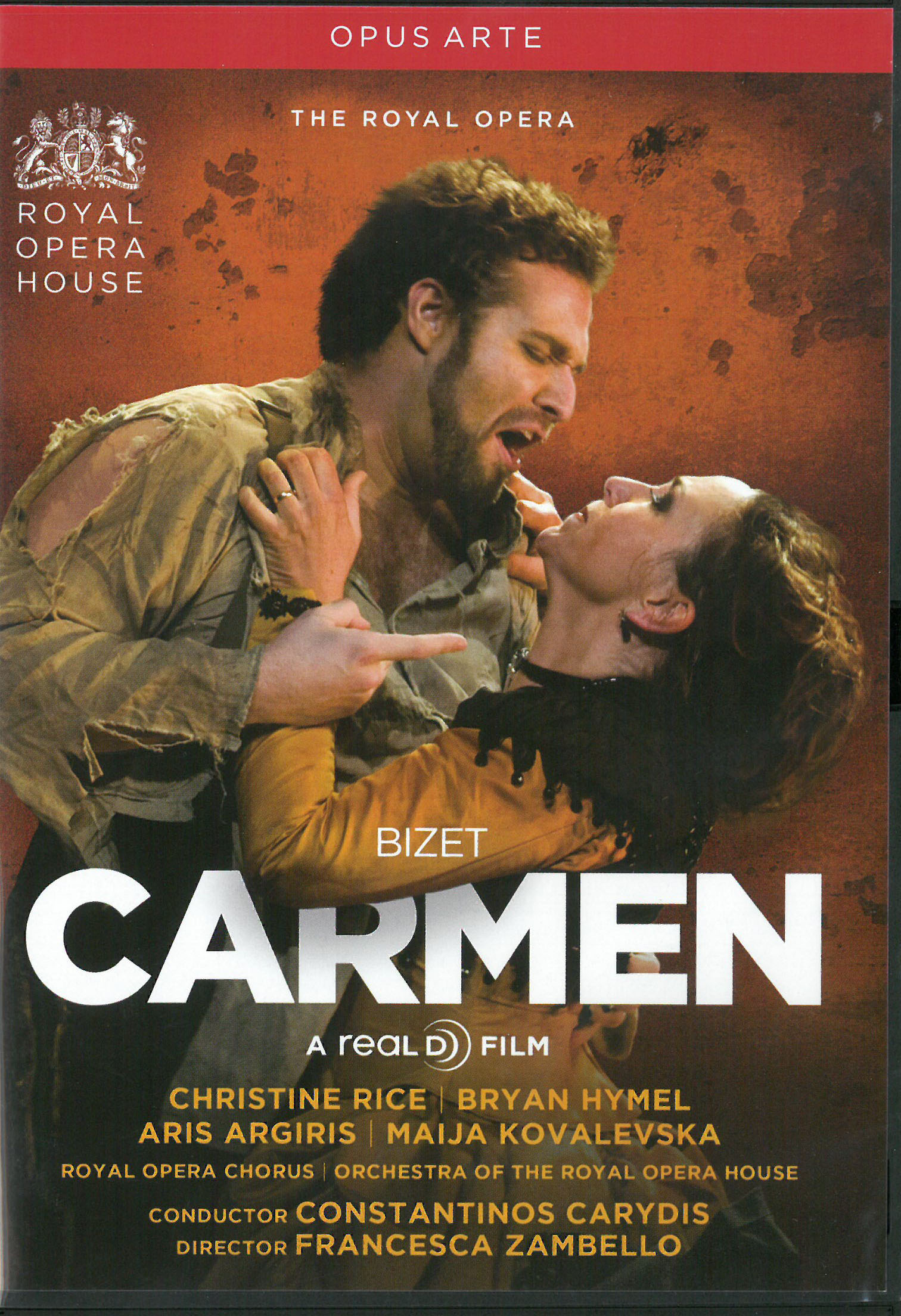 This release calls itself a film, but in reality it’s a DVD of Francesca Zambello’s 2006 staging that has seen better days like Jonas Kaufmann and Anna Caterina Antonacci, big name stars, but in another video. There were movies made of Carmen very successfully in the past with beautiful Seville as backdrop, real mountains, real bullfights, but this is nothing of the sort. It is shot in HD and even in 3D, obviously aimed at the mass market, because “Carmen sells” even for people who don’t know or care much about opera. The score is cut heavily by leaving out the “boring bits” like the intermezzos between acts, some of Bizet’s most beautiful music, making a rather short opera even shorter. The staging is traditional, expertly directed with unremarkable sets that leave lots of empty space for big crowds. There are all kinds of animals on stage, chickens, a donkey plus a beautiful black horse that carries in the torero Escamillo (Aris Argiris) who sings his big entry number on horseback. The production deserves praise for giving a chance to young singers who are attractive, enthusiastic, look the part, relaxed and athletic with fine, strong voices.
American tenor Bryan Hymel is no Alagna or Kaufmann, but has a strong, attractive voice and a certain vulnerability of character that makes him a believable Don José. His Flower Aria gets the biggest applause, deservedly. The role of Carmen is certainly what makes or breaks this opera and ROH chose mellifluous British mezzo Christine Rice who puts in an energetic and compelling performance and develops her character nicely from a seductress to tragic, defiant heroine, but the seconda donna, Maija Kovalevska (Micaela), an already highly accomplished Latvian soprano of wonderful stage presence, is a nice surprise and a joy to hear and behold.
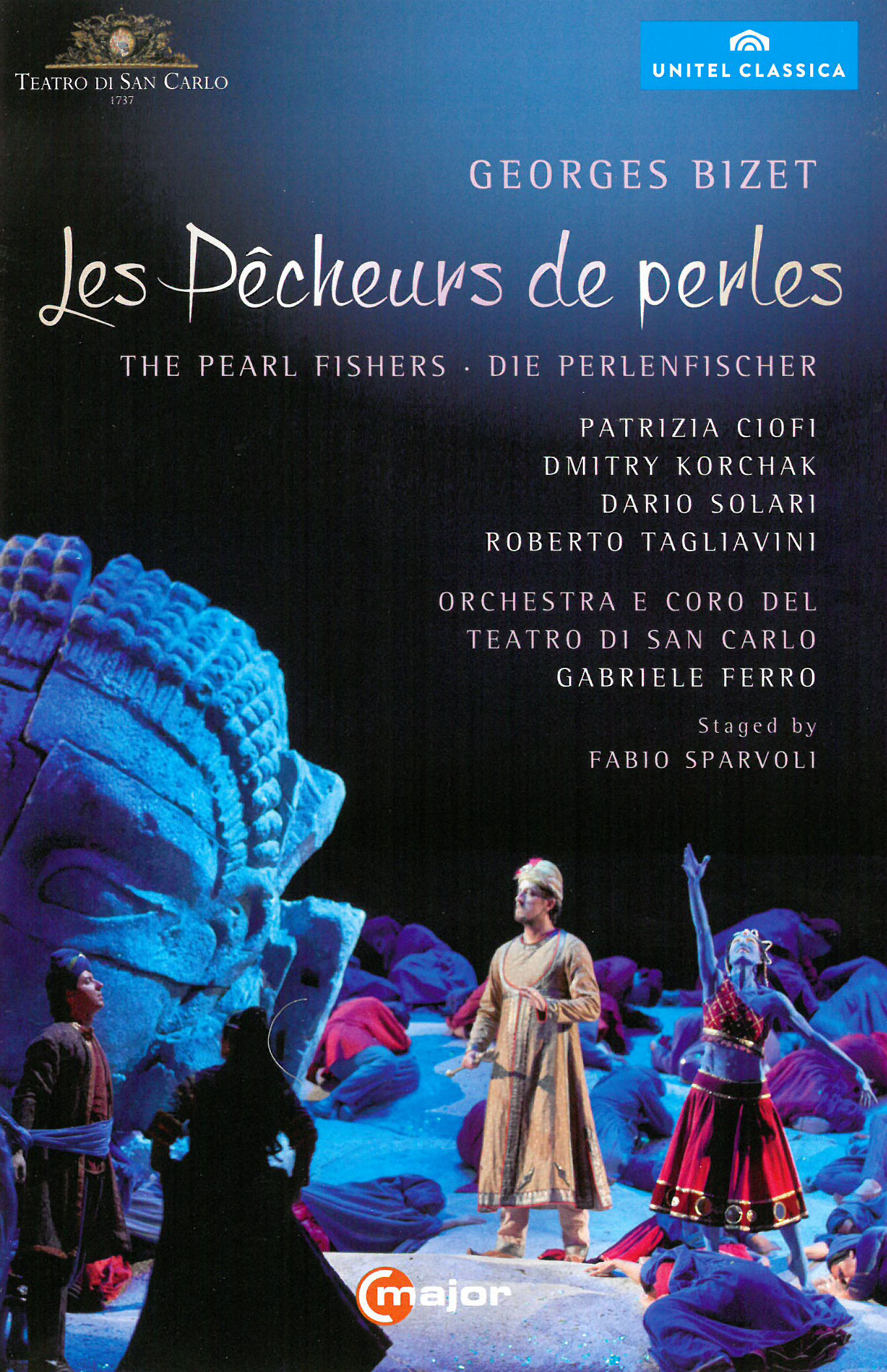 Most likely known by the famous duet Au fond du temple saint between the two male principals, Bizet’s second most famous opera has shared the fate of Carmen by being a disastrous failure on its premiere, so totally unappreciated by the French petit bourgeoisie that it pushed its genius composer into an early grave.
Nevertheless Les Pêcheurs de perles remains an exotic, atmospheric, gorgeously melodic score, coming to us from the resplendent 18th-century San Carlo opera house of Naples that has a 250-year tradition of singing excellence. Fabio Sparvoli’s visionary staging, all in shades of beautiful blues, evokes sultry Arabian Nights. There is an ever-present ballet of sinuous dancers representing the spirits of the sea, sometimes playful, sometimes menacing as in the third act when it all turns into bloodthirsty madness.
The heroine is a beautiful priestess enslaved by the Brahmins to keep her chastity on pain of death, but she defies her fate by falling in love, bringing on the wrath of Brahma, the creator god, and the morbidly superstitious mob of the pearl fisher community. Italian spinto soprano, Patrizia Ciofi, famous for her supple, light, wonderfully expressive voice, deserves the highest praise as the priestess Leila, a role ranging from religious chant to dreamy love song in the night, a love duet and later tempestuous rage fighting for the life of her beloved. The lover, Nadir, is Russian lyric tenor sensation, Dmitry Korchak, who delivers the romance Je crois entendre encore, one of the most beloved melodies ever written and even turned into a pop song. Uruguayan baritone Dario Solari is a powerful and noble Zurga who gives up the girl he loves and brings death on himself by letting the lovers escape. Conducted with great expertise by the 80-year-old master, Gabriele Ferro. Beautiful story, enchanting music, eye-popping scenery. A moving performance.
 Nielsen – Saul & David
Reuter; Riis; Petersen; Kristensen; Staugaard; Resmark; Royal Danish Orchestra and Opera Chorus; Michael Schønwandt
Dacapo 2.110412
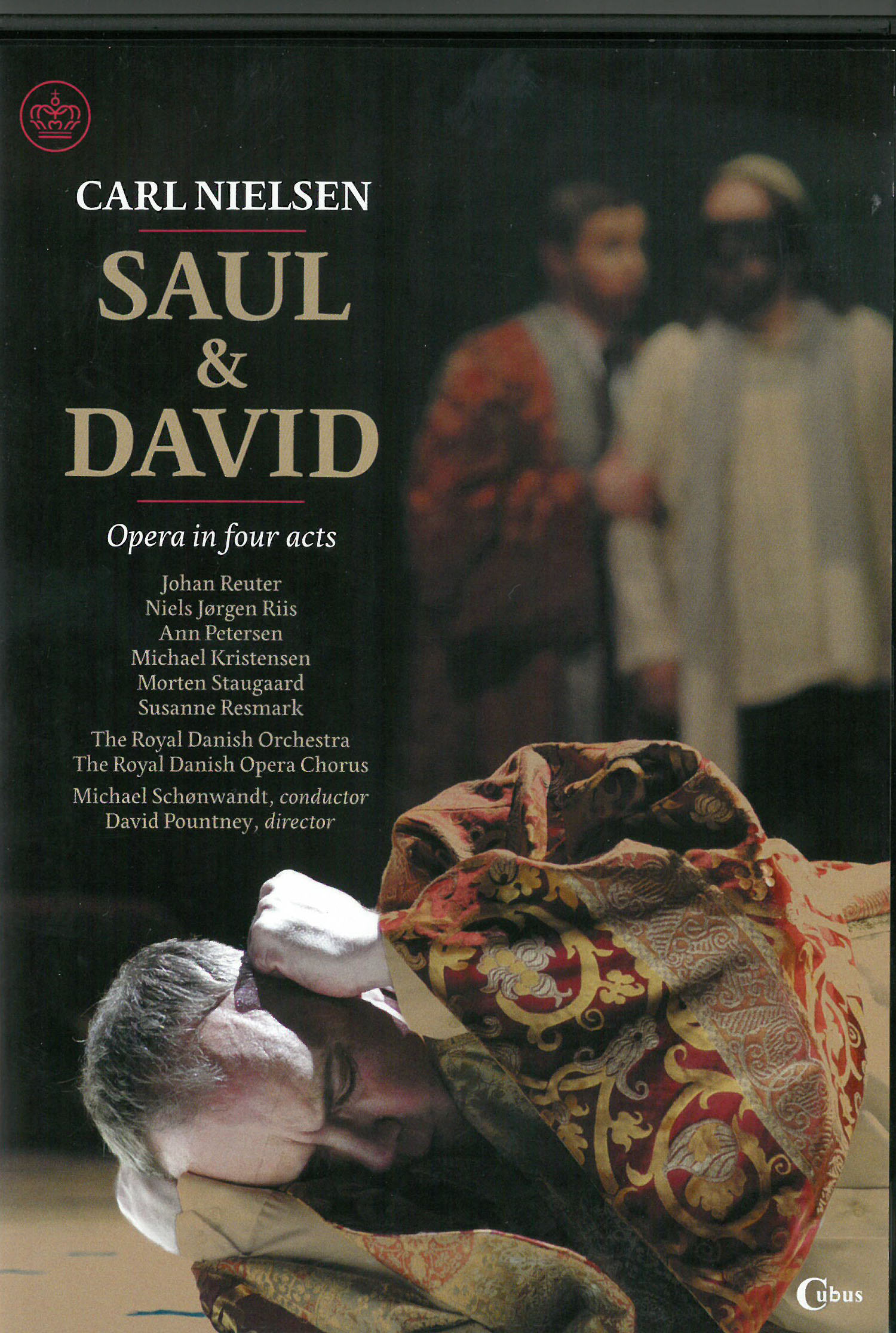
This exciting DVD presents Carl Nielsen’s remarkable opera Saul and David (1901) recorded live at the Royal Danish Opera, in a production celebrating Nielsen’s 150th birthday. It offers a stellar cast, Michael Schønwandt’s brilliant conducting, David Pountney’s provocative stage direction and optional English or Danish subtitles. The work’s availability on DVD should gratify both Nielsen fans and novices.
Bass-baritone Johan Reuter is outstanding as the conflicted King Saul. Through powerful acting and expressive singing he defines the dominant yet crisis-ridden character effectively. Morten Staugaard, as implacable Samuel, and Susanne Resmark, as the Witch of Endor, are surely highlights. Tenors Niels Jørgen Riis (David) and Michael Kristensen (Jonathan) and soprano Ann Petersen (Michal) are strong individually and in ensemble; David grows from a tentative opening to energetic emergence as the new king. This approach, to be sure, limits his vocal effectiveness in Act One, compared to David’s harp-accompanied solo and romantic duet with Michal sung by Alexander Young and Elisabeth Søderstrom on an Opera D’Oro CD of the work.
Pountney’s production updates Saul and David to our contemporary world: people in apartments watching the action on television; witty choreography of instrumental preludes suggesting frustrating peace negotiations. The director describes Samuel as a religious fundamentalist, restricting us, I think, from considering adequately his prophetic vision for the people of Israel. By the end, though, tremendous performances of Nielsen’s stunning choruses and orchestral support do convey fully the people’s convictions.
 Rautavaara – Rubaiyat; Balada; Canto V; Four Songs from Rasputin
Gerald Finley; Mika Pohjonen; Helsinki Music Centre Choir; Helsinki Philharmonic; John Storgårds
Ondine ODE 1274-2
Amongst the works that took the composer’s entire life to complete, pride of place belongs to Rubaiyat. Rautavaara vowed to set Edward FitzGerald’s 19th-century translation of The Rubaiyat of Omar Khayyam in 1949, while still a music student. It took 63 years and prodding in the form of a commission from Wigmore Hall for a song cycle destined for Gerald Finley. Well, it was well worth the wait. Rubaiyat is nothing short of a magical piece of music. Over the years, Rautavaara’s musical style transmuted from neo-classicism, dodecaphony, serialism, neo-romantic and post-modern styles into a unique synthesis of all of these, as Kimmo Korhonen writes in detailed liner notes. The music shimmers and glistens, while creating quite a challenge for the voice – the almost continuous melodic lines, requiring circular breathing. Finley, whose voice sounds even better than in the past (a small gift that Father Time dispenses to some baritones and mezzos) excels at bringing into his interpretation the philosophical stance of Khayyam. The rich mix of orchestral and vocal colour is intoxicating. This is most definitely one of those gems that will be taken out of its box and admired frequently – both by listeners and singers. The rest of the album is by no means just filler. It contains Balada, an abandoned and then truncated opera based on texts by Lorca, and arias from Rautavaara’s latest opera, Rasputin.
The young Finnish tenor, Mika Pohjonen and the Helsinki Music Centre Choir are perfect partners to Finley in this venture.
 Jennifer Higdon – Cold Mountain
Gunn; Leonard; Fons; Hunter Morris; Honeywell; Santa Fe Opera; Miguel Harth-Bedoya
PentaTone PTC 5186 583
The PentaTone series continues with yet another world premiere recording, this one better known as an award-winning novel (and a Hollywood movie starring Nicole Kidman and Renée Zellweger). A Civil War epic detailing the desertion and journey home of confederate soldier W.P. Inman and the struggles of his faithful wife Ada, Cold Mountain is much admired by both readers and filmgoers. This creates a problem of its own – the towering libretto, faithful to the book, seems to subjugate Jennifer Higdon’s music and almost relegates it to a form of soundtrack. Higdon is a well-regarded composer and recipient of a Pulitzer Prize, a Grammy and a Guggenheim Fellowship. Here, the constraints of the opera bear heavily on her, stifling full creative freedom. She still delivers a score full of beautiful moments and mesmerizing violin writing, managing to endow each character with a musical signature of their own. While listening to this recording, one can only imagine how much greater the music could have been if only it were burdened with a lesser-known libretto.
I have no doubt that Cold Mountain was more successful on stage. In fact, the visuals would have helped greatly and perhaps this release should have been a DVD film. For listeners familiar with the book and the movie, it will be a fine reminder of their experience. For the rest of the audience, it may remain a mystery – an opera hesitant to assert itself beyond the libretto. The cast is uniformly good, and we must add a shout-out to Toronto’s own Robert Pomakov, whose agile bass is a pleasure to hear.
 Rosanna Scalfi Marcello – Complete Solo Cantatas
Darryl Taylor; Jory Vinikour; Ann Marie Morgan; Deborah Fox
Naxos 9.70246-47
Rosanna Scalfi was an initially self-taught singer with a strong voice and an exceptionally wide range. Her social background was quite humble. Benedetto Marcello, the Venetian nobleman and composer, heard her and she became first his pupil, then his (secret) wife. These cantatas used to be attributed to Benedetto Marcello and have only recently been assigned to Rosanna Scalfi Marcello. They are her only known compositions.
The cantatas are very much in the style of Alessandro Scarlatti and the young George Frideric Handel earlier in the 18th century. Each cantata has two arias, separated by a recitative; in many cases a recitative also comes before the first aria. Each aria is structured as a da capo: the initial section establishes the key of the piece, a middle section gives us a contrasting key or keys, while the conclusion goes back to the key originally established. John Glenn Paton, in an informative essay that comes with these discs, points out that there is considerable experimentation within the conventional framework. The second recitative in the cantata Ecco il momento, for instance, begins in F-sharp minor, then works its way towards the remote key of F Minor before moving back to the original key.
It is a pity texts are not available, not even on the Internet. There is, however, a recent edition of the score by Paton and Deborah Hayes, published by ClarNan Editions (clarnan.com).
Texts and translations are available on the Naxos website (naxos.com/sungtext/pdf/9.
The cantatas are beautifully sung by the countertenor Darryl Taylor with able assistance by Jory Vinikour, harpsichord, Anne Marie Morgan, baroque cello, and Deborah Fox, theorbo.
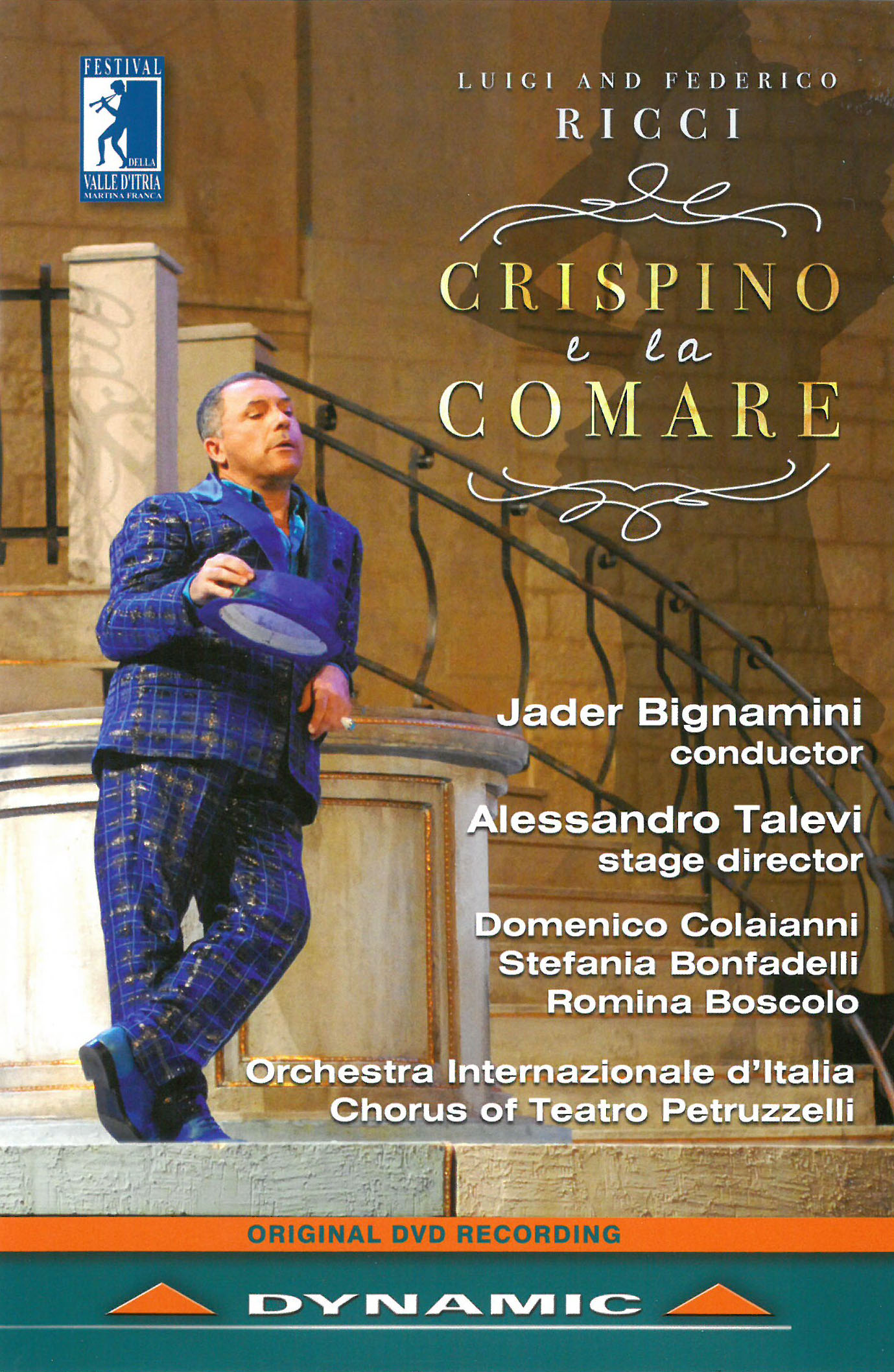 Luigi and Federico Ricci – Crispino e la Comare
Colaianni; Bonfadelli; Boscolo; Orchestra Internazionale d’Italia; Chorus of Teatro Petruzzelli; Jader Bignamini
Dynamic 37675
The operas by the brothers Luigi and Federico Ricci were popular in their day which was the middle of the 19th century. Now they are rarely performed, although there was a recent staging of Federico’s La prigione d’Edimburgo in Edinburgh, an apt choice since that opera is based on Sir Walter Scott’s The Heart of Midlothian. There have been a few modern revivals of Crispino e la Comare, beginning with that in Wexford in 1974. The production on this DVD was filmed at the Valle d’Itria Festival in Marina Franca, in Puglia, in 2013.
Although the librettist is Francesco Maria Piave, now largely known for his work with Verdi, and although the Riccis called the work Melodramma fantastico giocoso, this is really old-fashioned opera buffa, with little of the seriousness which Goldoni and Galuppi had introduced in the late 1740s, let alone the way da Ponte and Mozart transformed the genre in the 1780s. Conductor and director are good at keeping the action moving. Some of the acting, however, is diabolical. The best performance comes from the baritone Domenico Colaianni as the much-put-upon cobbler Crispino, while the soprano Stefania Bonfadelli as Crispino’s wife Annetta copes well with her technically demanding part. A cute little dog comes close to stealing the show. I suppose that is inevitable once you introduce animals!