01 SolsticeSolstice
Adam Cicchillitti; Denis Plante; Orchestre Classique de Montreal; Jean-Marie Zaitouni
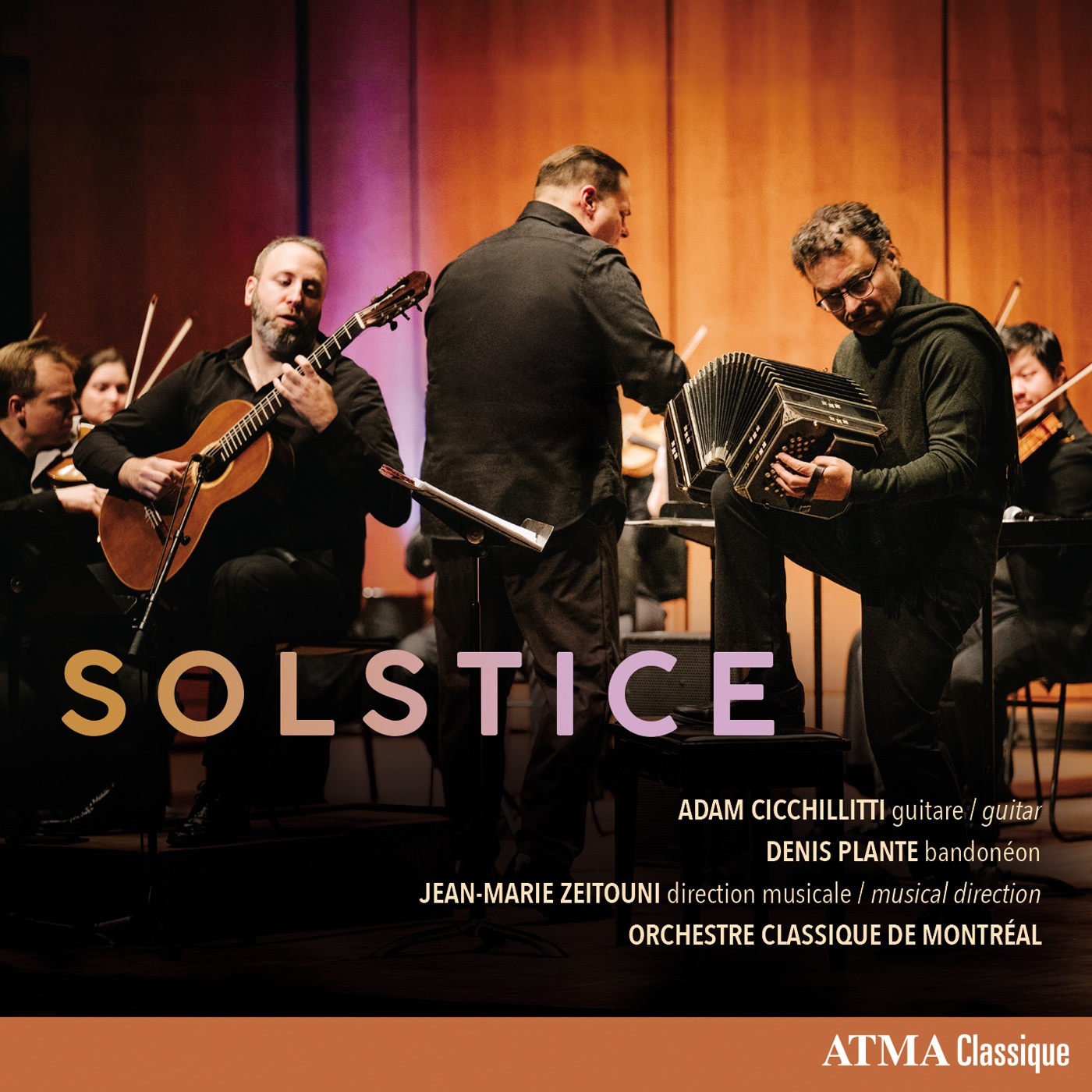
ATMA ACD2 2936 (atmaclassique.com/en/product/solstice-adam-cicchillitti-denis-plante-astor-piazzolla)

Denis Plante (bandoneon) and Adam Cicchillitti (guitar) collaborate and “join” Orchestre classique de Montreal under conductor Jean-Marie Zeitouni as integrated solo voices, creating a balance point, like a solstice. Instrumental colours, conversations, styles like classical, tango, dance, popular and jazz explore and combine Southern/Latin American and Northern/contemporary Canadian music traditions.

Plante’s composition Ciudad-Soledad is the perfect introduction. Loud opening with rhythmic orchestral music and bandoneon lines. Melodic conversations between bandoneon and guitar above accented symphonic beats lead to a slower mid-section with solos. The pace gradually picks up resulting in a closing highlighted with accented chords. 

Mexican Manuel M. Ponce’s three movement Concierto del sur blends in Spanish modal inflections. The Allegro moderato movement has alternating guitar and hushed orchestra lines and accents, featuring Cicchillitti’s colourful playing of detached picked strings, contrasted with smoother melodic lines. 

Astor Piazzolla’s tango-nuevo style Hommage à Liège (1984) is a three-movement double concerto for bandoneon, classical guitar, and symphony. Introduction has a sad, serious guitar solo until the bandoneon enters with quieter harmonic lines and melodies. Third movement Tango opens with Plante’s brilliant bandoneon playing, then a full orchestral tango with driving rhythms.

Plante’s enticing arrangement and performance of Piazzolla’s Oblivion for strings, bandoneon and guitar maintains Piazzolla’s expressive milonga style melody and arpeggiated accompaniments. Canadian Luis Ramirez’s Sola from his Immigration Suite for string orchestra and bandoneon has strident tango style high pitched strings against lower orchestral chords hauntingly suggestive of troubling immigration experiences.

The Canadian musicians perform these timeless compositions passionately.
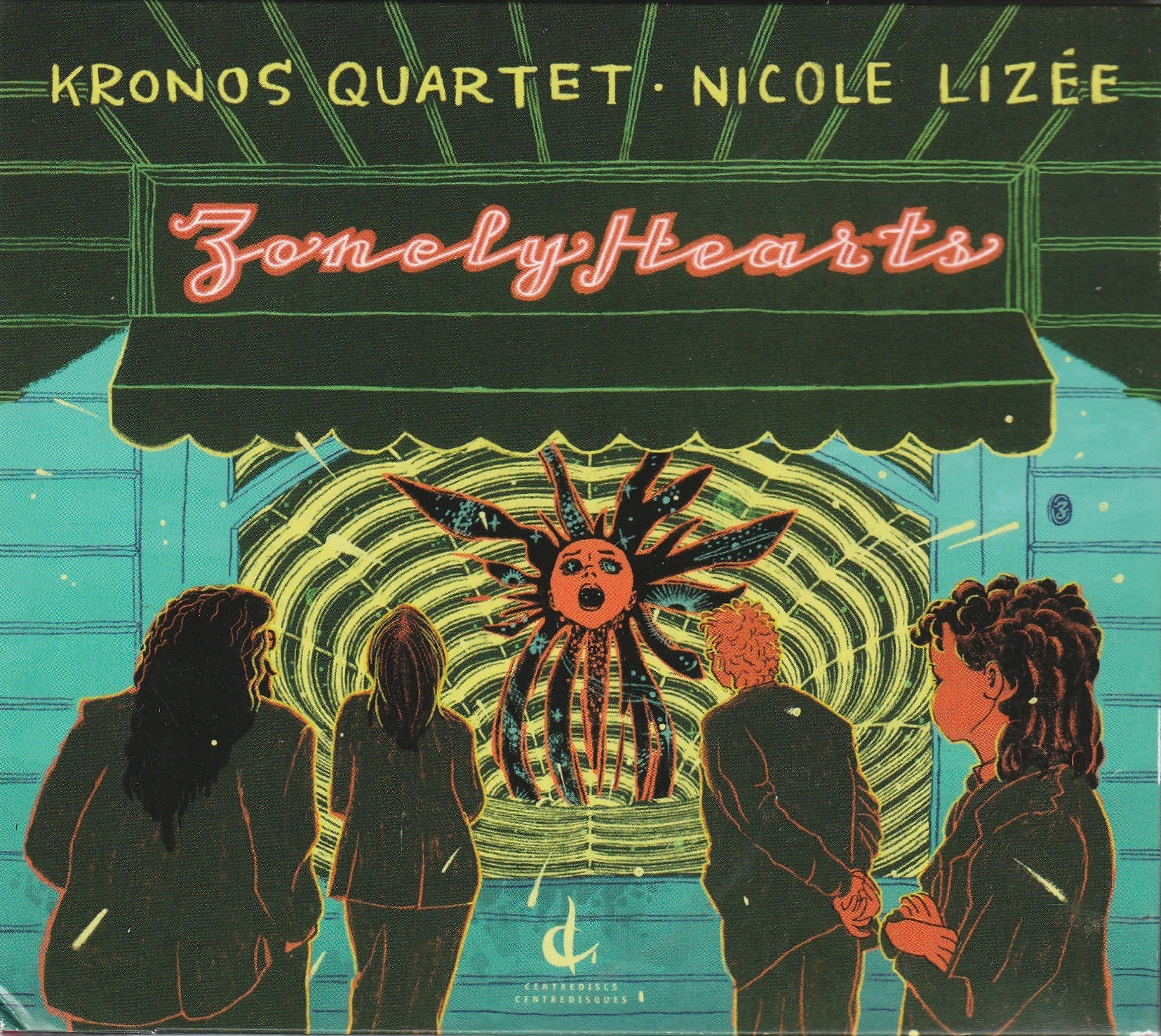
02 Nicole LizeeNicole Lizée – Zonely Hearts
Kronos Quartet; Nicole Lizée
Centrediscs CMCCD 34625 (centrediscs.bandcamp.com/album/nicole-liz-e-zonelyhearts)

When longtime friends and collaborators such as the Kronos Quartet and Nicole Lizée build a project after 16 years, you can expect something extraordinary. Zonely Hearts, the latest from Kronos, is the delicious party we all get to attend.

Beginning with Death to Kosmische, Lizée begins to weave her magic, reflecting on her “love/hate relationship with the idea of genres.” The immediate dissection of the Kosmische style (a 1970s West German experimental electronic genre focused on ambient, space-inspired soundscapes and innovative synthesizer use) is superbly described by blending “archaic” technologies with composed strings to emulate delays and effects. The quartet becomes a single entity, nearly a parody of the former style while holding it up to the light for the transparencies to blossom layer by layer through the magic of Lizée’s compositional creativity.

The Golden Age of the Radiophonic Workshop (Fibre-Optic Flowers) was born from a BBC project in the 1960s where electronic music was beginning to take shape, and sound sources were gleaned from everyday objects. Organic sounds were then recorded and shaped electronically. Lizée takes the former workshop even further by creating a palette of sounds played in real time, melding synthetic sounds with the analog objects in a structured musical expression.

Black Midi’s title refers to the layering of thousands of notes on MIDI (Musical Instrument Digital Interface), virtually “blackening” it; here the composer uses it as a starting point, exploring the possibility of being in the style of film shorts where the performers enhance or manipulate each scene, and the compositional technique is nothing short of brilliant in its effect. 

The final track Zonely Hearts takes cues from Rod Serling’s The Twilight Zone; being the most recently composed piece (2021–2023), it’s more relevant than ever, describing “mind control, censorship, surveillance, brainwashing, and revisionist history through altering and banning books.” Here the quartet confirms their bond with the composer, becoming one relentless entity of humanity in a sea of restlessness.

The booklet artwork aptly describes the music, and a DVD of live performances is included.

03 Noise Trip ExplosionNoise Trip Explosion
Nolan Hildebrand
Redshift Records TK576 (edshiftmusicsociety.bandcamp.com/album/noise-trip-explosion)

Toronto-based composer/performer Nolan Hildebrand blends his composing for acoustic instruments with electroacoustic processing methods using a live feedback mixer, data-generated noise, and interactive electronics. Performed by Toronto musicians Colin Fisher (saxophone), Veronica Zupanic and Roan Ma (violins), Hirad Moradi (piano), Patrick O’Reilly (guitar) and a host of percussionists, we are treated to five experimental works composed between 2022 and 2025.

Generative open graphic score #1 features Fisher playing from a Rorschach-like graphic score, and improvising. Hildebrand operates the live mixer to capture Fisher’s solo saxophone playing, and to create “noisy” saxophone feedback. Hildebrand either keeps them separated or fused together, making this brilliant harsh work volatile and perhaps difficult listening, but forever worth the effort. There’s more live Hildebrand electronic manipulations of Zupanic, O’Reilly and Moradi in knurl cracked green, with clear instrumental/electroacoustic shorter parts, and fascinating colours. 

Ma plays from an open graphic score with an electronic audio part drawn from raw data from hundreds of files in Raw Data Speed Demons. In portals II (everywhere and everything right now) Fisher, O’Reilly and Louis Pino (drum kit, tam-tam) choose to play alone or with each other via coloured shaped portals, without any processing from Hildebrand, but wide spanning electronic sounds create his illustrious sonic self-defined “multiple sound universes.” The disc concludes with DADA Bender for percussion sextet, fixed media electronics, mixer feedback and data bending, resulting in a lighter, more fun work.

Though at times loud, loud, loud, harsh and intense, these are diverse contemporary musical sounds to relish.

04 David OcchipintiLooking Glass
David Occhipinti; various artists
Elastic Recordings OM 009 | ER 027 (davidocchipinti.bandcamp.com/album/looking-glass-elastic-recordings)

Partly inspired by literature – In particular the logic-defying works of Lewis Carroll – David Occhipinti shows himself to be a masterful storyteller through the medium of the string quartet throughout Looking Glass. It makes sense that he would thrive in this medium, given his commitment as a compositional mind to precise detail, intricate phrasing, subversive metrical considerations and contrapuntal flair. 

This may not be a string quartet in the traditionalist sense, as Occhipinti’s own guitar exists in place of one of the violins, but it is certainly one in the expressive, tonal and literal (there are four stringed instruments present) sense. In any case, it would be folly to treat the other three members of the quartet as if they were mere canvas for Occhipinti’s vision; Aline Homzy (violin), Steven Dann (viola) and Maria Zachariadou (cello) each provide their own emotive depth and interpretive verve to their parts. 

Through each piece, the quartet continuously shifts modes of interchange in the holistic sense and in the internal sense. The Fruminous Bandersnatch, the album’s longest track and in certain thematic respects its centrepiece, is a 13-minute-long conversation where nary a word is uttered. The guitar and the trio trade purely gestural tangents and anecdotes, until it builds into a fiery exchange that is the instrumental equivalent of impassioned interlocutors talking over each other; yet the whole affair never ceases to be pretty. Looking Glass is an apt title, as the album is a perceptual odyssey.

01 Alice Ho ImagineAlice Ping Yee Ho – The Imagined
Christina Petrowska-Quilico
Navona Records nv6857 (navonarecords.com/catalog/nv6857)

There are, of course, composers who are also world class instrumentalists and vice versa. But in the storied tradition of classical piano, there are meaningful creative relationships formed when a composer writes specifically for a particular performer, or (such as with Hewitt and Bach, Lipatti with Mozart, or Rubenstein with Chopin) when a pianist becomes associated with the work of a particular composer, their recordings dubbed seminal and definitive. I am not sure what will come of the musical relationship between the Hong Kong-born Canadian composer Alice Ping Yee Ho and renowned pianist Christina Petrowska Quilico—who brings tremendous expressivity and nuance to each of Ho’s four terrific compositions here—but it has been a great one so far.

`Released in 2026 on Navona Records, The Imagined is a shortening of Ho’s four-part evocative composition Pictures from An Imagined Exhibition which draws inspiration from the paintings of both the late Hong Kong-based artist Wesley Tongson and, believe it or not, Petrowska Quilico herself, who is also an accomplished artist (for reference, she painted the album’s cover). Attempting to highlight the differences seen in these artistic approaches (the album’s notes point to contrasting Eastern and Western aesthetics), Ho and Petrowska Quilico effectively co-create an intricate musical landscape of geographic and artistic cross-pollination, which they mine effectively over this beautiful album’s first 18 or so minutes.

Recorded last year at Imagine Sound Studio in Toronto, the sonic capture of Petrowska Quilico’s piano is rich and clean, enabling revelatory further elegances to be appreciated in both the playing, and in Ho’s compositional work.

Listen to 'Alice Ping Yee Ho: The Imagined' Now in the Listening Room

02 Walk the Darkness DownChristopher Mayo – Walk the Darkness Down
Andrew Noseworthy; Grace Scheele
people | places | records (peopleplacesrecords.bandcamp.com/album/walk-the-darkness-down)

Toronto-based composer Christopher Mayo has created amazing, unforgettable, experimental music here in three compositions written between 2019 and 2023.The electric guitars are performed by Andrew Noseworthy, harp by Grace Scheele, and other effects by Mayo himself.

Mayo says Townes Van Zandt’s 1965 track Lungs was his reference point for the opening guitar track Walk the Darkness Down. Noseworthy plays and records ten electric guitars with open tunings that have been slightly ‘detuned’ to match the guitar on Van Zandt’s album, as a layered background, with a solo electric lead over top. Percussive mallets create more “noisy” effects. The ten guitars are unified yet sound separate too. Accented intervals and chords, ascending and descending slides, low held notes and strums become more frequent. The noise is gradually eliminated as the loud chords, held notes and accents are separated by silent spaces leading to a vibrating single note ending. 

Composed for this release, A Sick, Sly Age for harp and electric guitar is transfixing. It opens with prepared harp rattling and slow electric guitar, then a single repeated hypnotic note through to close, its almost toe-tapping quality making the harp and electric guitar lines more interesting. 

The closing harp solo It Could Be You or You or You has Scheele play quietly while pushing the composition’s written lines from soft start to attention grabbing high harp pitches ending. This perfectly composed/performed/recorded release is for all listeners regardless of musical tastes, ranging from tonal to atonal, comforting soft sounds to loud pseudo crashes. Love it!!

Back to top