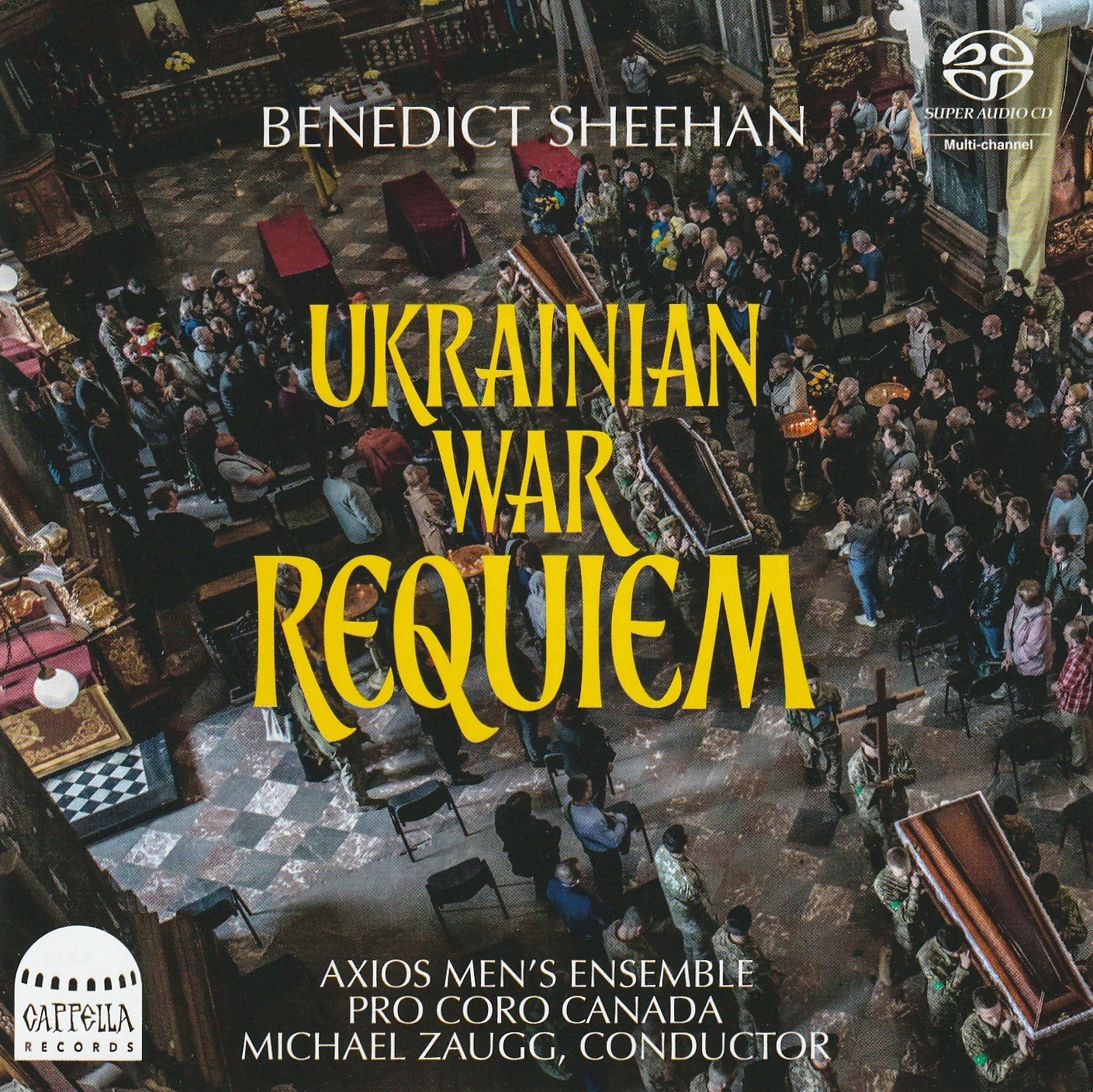
07 Ukrainian War RequiemBenedict Sheehan - Ukrainian War Requiem
Axios Men's Ensemble; Pro Coro Canada; Michael Zaugg
Cappella Records CR432 SACD (axioschoir.com)

After Russia invaded Ukraine in February, 2022 American Benedict Sheehan received a commission from Edmonton’s Axios Men’s Ensemble, performers of Eastern European sacred music, many of its singers sharing Ukrainian roots. Sheehan was asked, he writes, for “a new composition in honor of those fallen in Ukraine’s struggle for freedom.”

Sheehan’s Ukrainian War Requiem was premiered in Edmonton on April 14, 2024 with the Axios Men’s Ensemble and the tenors and basses of Edmonton’s Pro Coro Canada conducted by Pro Coro’s artistic director, Swiss-born Michael Zaugg.

In keeping with Ukraine’s mixed religious heritage – Orthodox, Catholic and Jewish – Sheehan drew texts from the Ukrainian Memorial Service, hymns of St. John of Damascus, Psalms 50 and 90, the New Testament Gospels and the Latin Requiem Mass. He combined, he says, “a variety of musical influences, including Ukrainian and Galician plainchant (somoilka), Gregorian chant, a Ukrainian Jewish psalm tone (nusach) and an array of original melodies,” as well as Shche Ne Vmerla Ukraïna (Ukraine Has Not Yet Perished), Ukraine’s national anthem.

Throughout the work’s 67 minutes, the richly sonorous men’s chorus sings with fervent urgency in Ukrainian, Latin and English, several choristers contributing solos; the major solos are sung by Ukrainian soprano Yuliia Kasimova and Canadian tenor John Tessier. Based on traditional church modes, Sheehan’s powerful, often heart-rendingly beautiful score is a loving tribute to the Ukrainian dead that deserves to be heard everywhere in remembrance of all victims of all wars.

08 O ListenO Listen to the music of Uros Krek & Else Marie Pade
Danish National Vocal Ensemble; Marina Batic
Our Recordings 8.226924 (ourrecordings.com/albums/o-listen)

This is the ninth release in a series of challenging projects from the Danish National Vocal Ensemble on Our Records. The professional chamber choir scene, especially amongst the Nordic countries, including Canada, is one of the most musically fecund departments in contemporary music. Choirs just seem to be getting better and more capable of negotiating ever newer compositional demands.

The retro graphic on the cover, a clunky ear, suggests that this release is odd. The disc opts to investigate some out-of-the-way developments around the middle of the 20th century. The Slovenian conductor of this ensemble, Martina Batič, has chosen two rarely exposed composers, one a fellow Slovenian, Uroš Krek, and Danish music concrète practitioner Else Maria Pade. 

Krek has a mid-century choral style that is closest to Gerald Finzi in the three English language pieces included, but the subsequent pieces in Slovenian and Latin show several attractive elements of his very solid style.

Pade’s mellifluous style fits well with standard mid-century practices, although she never sounds English. The real curate’s egg on this disc is one of Pade's electronic projects, an immersive environment meant to go around a challenging stratospheric coloratura soprano, baritone, speaking (like zombies) chorus and seven trombones. The electronic background includes assembled sounds. The very brief trombone chords and notes really make this piece. 

Performances throughout the recording are all supremely beautiful.

Listen to 'O Listen' Now in the Listening Room

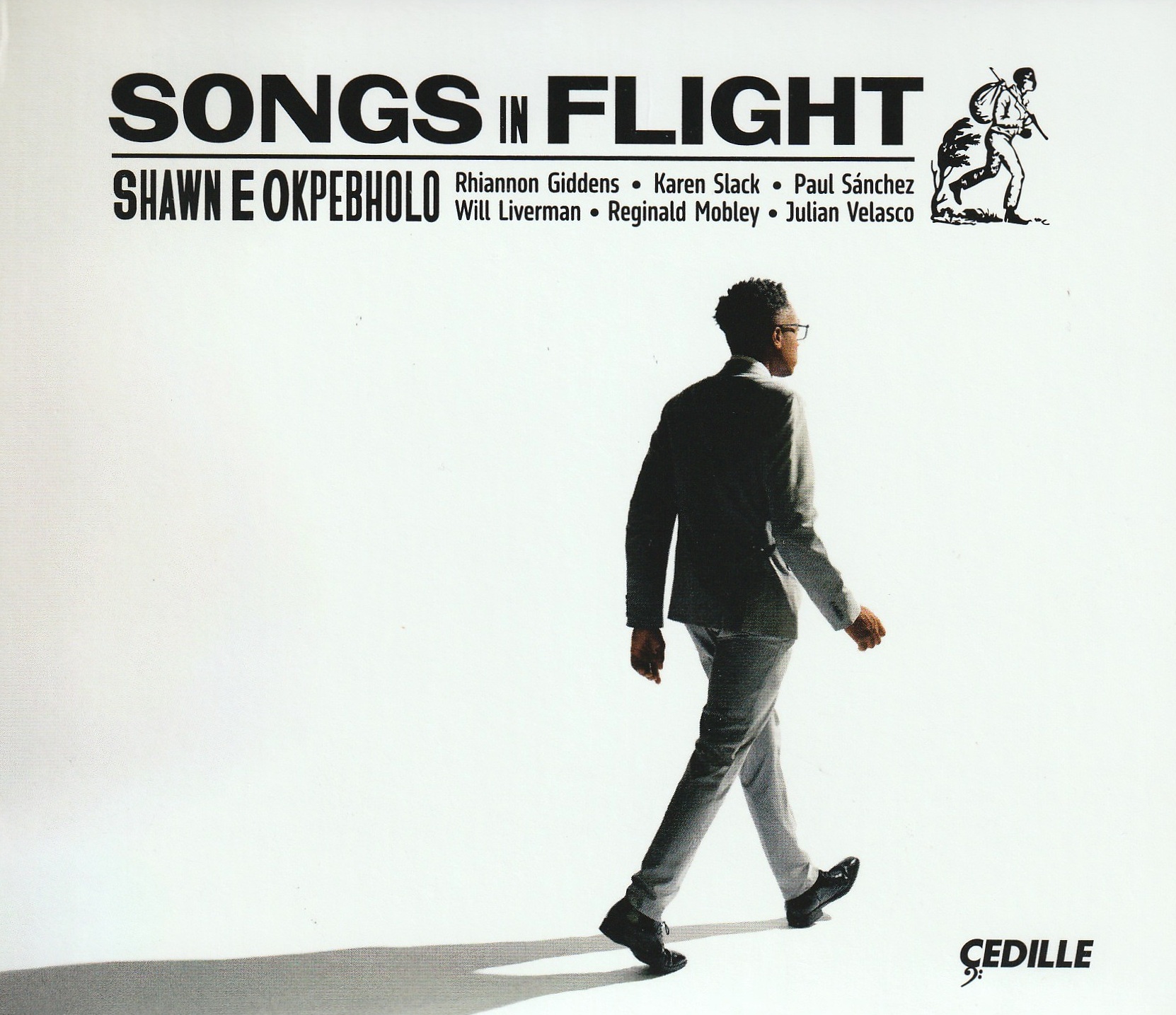
09 Songs in FlightShawn E Okpedholo - Songs in Flight
Rhiannon Giddens; Karen Slack; Paul Sanchez; Will Liverman; Reginald Mobley; Julian Velasco
Cedille Records CDR 90000 234 (cedillerecords.org/albums/songs-in-flight)

Shawn E. Okpebholo’s exquisite disc Songs in Flight, strikes me as being an incredibly beautiful – and disturbing – new palimpsest of the American Spiritual. The uncomfortable truth of each song cuts to the quick, deep within the heart. 

Okpebholo's songs repurpose news stories of young boys and girls escaping slavery during the 18th and 19th centuries using the language of poetry. His music turns the narratives into arias sung by lyric soprano Rhiannon Giddens, mezzo Karen Slack, baritone Will Liverman and renowned countertenor Reginald Mobley. Paul Sánchez’s pianism and a forlorn saxophone accentuate the dark atmosphere.

Missing may be the story of Emmett Till, but spirituals about Ahmaud Arbery and Trayvon Martin tell their tragic stories with fervour and operatic flair. In particular the lynching of Arbery is a painful gut-punch and even complements Sing, O Black Mother by Langston Hughes. 

Slavery has deep roots, its history spanning diverse cultures and geographical regions. But the transatlantic slave trade and its institutionalization on plantations has had a profound and enduring impact on the history of the US, leaving an indelible legacy of racial injustice and inequality that continues to resonate today. 

“I said your name / first, choked in wondrous / love. Nothing more holy / than the first farewell. My womb, no longer / habitable. My song / was your first and only home.” – words by Wanda-Cooper Jones, Arbery’s mother on Ahmaud sung by Giddens, send a chill through the spine.

01 Handel Nine German AriasHandel – Nine German Arias
Nicole Palmer; Marika Holmqvist; Rebecca Humphrey; Barbara Weiss
Zenith Ensemble (zenithensemble.org)

Of Georg Frideric Handel it is believed – and certainly true – that of his contemporaries, only J.S. Bach produced work in which such qualities of robustness, lucidity and passion were so delicately balanced. These Nine German Arias, an exposition of rarely performed gems by baroque Zenith Ensemble - Nacole Palmer co-artistic director and soprano, Markia Holmqvist baroque violin, Rebecca Humphrey baroque cello, Barbara Weiss harpsichord - are an indisputable testament to this fact.

With immaculate consistency of sound and approach the Zenith Ensemble makes a more than fitting and generous celebration of this repertoire, confirming the organization’s high achievement of this period work. These are live-wire performances, technically excellent and propelled with exactly the right degree of eloquence and driving energy by Palmer. Her Handelian qualities are superbly showcased.

Palmer’s interpretations combine great imagination and musicality with a special ability to find details in the music that you maybe hadn’t registered before. Magically, she draws them out and thrills you with them. In Den Angenedmen Büschen and Süsser Blumen Ambraflocken are but two outstanding examples. 

I must leave room to laud the instrumental performers. They make things easier for Palmer. Bright but strong in tone, virtuoso but pressingly expressive, Holmqvist, Humphrey and Weiss display just enough distinctiveness that can touch the heart by revealing there are three other persons to Zenith, not just Palmer’s superb voice.

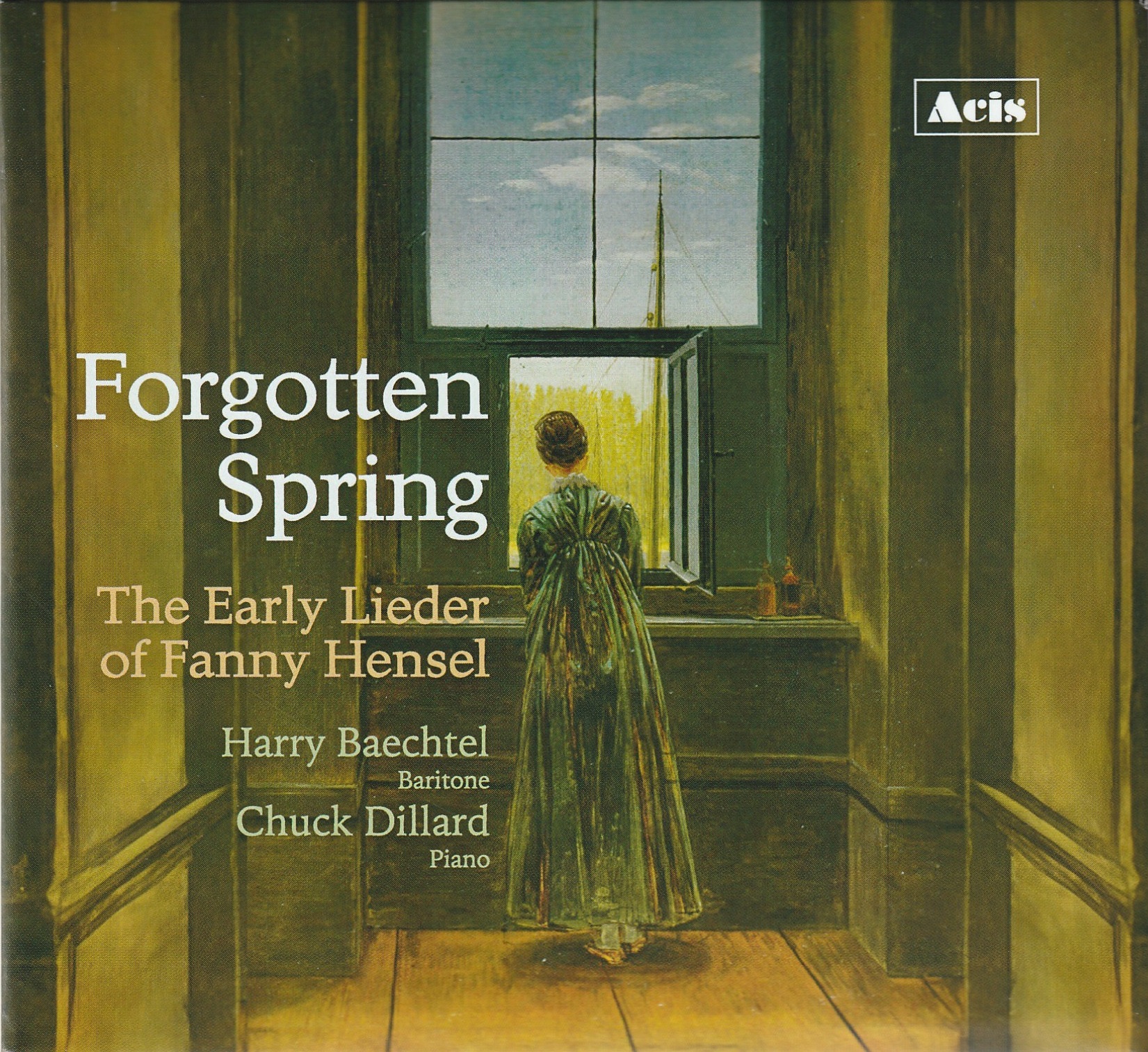
02 Forgotten SpringForgotten Spring – The Early Lieder of Fanny Hensel
Harry Baechtel; Chuck Dillard
Acis APL53882 (acisproductions.com/forgotten-spring-fanny-hensel-lieder-harry-baechtel-chuck-dillard)

A quarter of a century into our next millennium we are in the thrall of remarkable discovery, that of incredible music by women composers. These works include buried masterpieces by composers such as Clara Schumann, Florence Price – and most remarkable of all – hidden gems by the brilliant Fanny Mendelssohn Hensel.

Some of Hensel’s work has been performed and recorded (and reviewed here too). And now we have a disc of some of her most remarkable work. In fact, The Early Lieder of Fanny Hensel, displays a genius akin to her illustrious brother Felix.

Listening to this recording is a heady experience. It almost feels as if no expression would be hyperbole enough to express admiration for Hensel’s lieder. Her maturity – rare erudition with regard to the poetics of lied, sensitivity to lyric and finding the absolute perfectly suited melodic and harmonic conception to employ – is breathtaking. 

The extraordinary music interprets poems by Johann Peter Eckermann who lived in the long shadow of Goethe. Among other poets represented are works by Luise Hensel, Ludwig Tieck, Johann Henrich Voß and Sir Walter Scott.  

Meanwhile the deep and resonant baritone of Harry Baechtel captures the textural luminosity distilled into wondrous music. Moreover, the delicate pianism of Chuck Dillard makes for a perfect musical partnership.

Listen to 'Forgotten Spring: The Early Lieder of Fanny Hensel' Now in the Listening Room

03 Cohen Steal a PencilGerald Cohen – Steal a Pencil for Me
Opera Colorado; Ari Pelto
Sono Luminus SLE-20034 (sonoluminus.com/sonoluminus/steal-a-pencil-for-me?rq=pencil)

The evil Nazi era of the 30s and 40s stole more than six million lives. But that Holocaust during World War II held many miracles in secret. One of these unfolds on this exquisite double-disc, in a deeply expressive opera with short solo and duet arias and powerful recitatives, which goes like a bolted arrow directly to the heart.

Steal a Pencil for Me, by composer Gerald Cohen and librettist Deborah Brevoort, is a story of joy, hope and the imperative to survive in tender, requited eternal love (mixed in with elemental sadness and despair). Let’s also not forget a magnificent cast of opera stars playing principal characters and the cast of supporting artists together part of Opera Colorado, expertly shepherded by the conductor Ari Pelto.

Based on the book of the same name, the narrative is a quadrangular love story: among principal Jaap Polak (played with lyrical tenderness and strength by baritone Gidean Dabi) and his deeply empathetic wife Manja (brilliant Adriana Zabala), Jaap’s true love Ina Soap (the liquid soprano Inna Dukach) and her fiancé Rudi Cohen (the sublime, dramatic Daniel McGrew). Other roles are superbly played and include friends and family, three Nazis, and a chorus of nine with chorusmaster Sahar Nouri, who is also a pianist in the orchestra.

Act 1 telling of persecution in Amsterdam and the unfolding of the love story in Westerbork is brought to dramatic life. Act 2 depicts survival in Bergen-Belsen, a secret Passover celebration, lovers lost and reunited in a happy conclusion back in Amsterdam. The package includes booklet essays, Brevoort’s libretto driven by excellent cultural anthropology. Cohen’s vent is dramatic and dark, and atmospherically sinister. And operatically grand. The tenderness of the dénouement after short, outstanding operatic arias and recitatives is sustained throughout making for a memorable event.

01 Art Choral 2Art Choral Vol.2 – Baroque I
Ensemble Artchoral; Matthias Maute
ATMA ACD2 2421 (atmaclassique.com/en/product/art-choral-vol-2-baroque-i)

Those seeking the mesmerizing and magical in their choral listening will enjoy this album of works by 16th and 17th century experimenters such as Gesualdo, Schütz, Monteverdi and Purcell —part of an ATMA series comprising fifteen volumes of music from 16th to the 21st centuries. Matthias Maute and Quebec’s Ensemble ArtChoral achieve a deft ensemble dynamic while also delivering the soloist flair that is so needed in this repertoire. 

The opening track, Il Lamento d’Arianna by Claudio Monteverdi, sparkles with the “meraviglia” (wonderment) which the composer sought to depict, as discussed in the recent book Monteverdi and the Marvellous by Canadian scholar Roseen Giles. From the first words, (“Lasciatemi morire / Let me die”), their intensity and precision dissolves at times to sweetness, as it should.

Carlo Gesualdo’s music is known for its colourful word-painting, involving shifts from exaggerated chromaticism to melodious diatonicism. Especially effective on this recording is the reading of Tristis et anima mea, a church responsory set with the florid and dramatic style of a madrigal and delivered with the panache that Gesualdo deserves. 

Maute approaches the Purcell pieces differently than this reviewer has heard or sung before. Especially with Man that is Born of a Woman – and In the Midst of Life, into which it segues without credit – the pace feels so rushed that in places the dissonances and text settings fly by rather than lingering painfully as seems apt for a funeral piece. It is a bold choice, but the madrigal-like delivery is effective in such sections as “He fleeth as it were a shadow / and ne’er continuith...” One can’t imagine that the choir of Westminster Abbey sung it this way at Queen Mary’s funeral, for which it was composed, but this performance cleverly points to Purcell’s Italian influences and stands as an alternate interpretation of this rich and beloved repertoire.

02 Monteverdi Lost VespersMonteverdi – The “Lost” Vespers
The Thirteen; Matthew Robertson
Acis APL54148 (acisproductions.com/the-thirteen-monteverdi-lost-vespers)

The Thirteen is an acclaimed professional orchestra and choir of soloists that reimagines vocal music, from early chants and masterworks to contemporary world premieres. Their most recent recording, The ‘Lost’ Vespers, is the culmination of a five years passion project by the ensemble’s artistic director and founder, Matthew Robertson. The ‘Lost’ Vespers is a curated compilation that draws from Monteverdi’s end of life volumes, Selva morale e spirituale (1640-1641) and Missa et salmi (1650). With Robertson as conductor and Adrienne Post as concertmaster, The Thirteen presents a meticulously historically informed performance of Monteverdi’s sacred work. The ensemble is comprised of eight singers and seven instrumentalists, including violin, organ, cello, cornetto and theorbo. The songs alternate in the typical style of a vespers, generally between joyful celebrations and solemn reflections. 

The carefully considered musical choices are reflected throughout the album; the exquisite push-pull of pure sonorities that represents different parts of a vespers; the word painting, specific shape of sounds and rhythms executed with craftsmanship and precision, especially noteworthy in the Magnificat primo and in the Nisi Dominus; and the virtuosity that not only creates the expected beautiful outcome of technical capacities, but also a deeply intimate and affecting musical experience. 

The liner notes of the album provide a valuable source of information on the project. Robertson first shares the journey that led to the recording of The ‘Lost’ Vespers and Dr. Steven Plank, Professor of Musicology at Oberlin College and Conservatory, then provides a wealth of information that can guide or enhance the listener’s experience.

The ‘Lost’ Vespers was recorded at the Franciscan Monastery of the Holy Land in America in Washington, DC in October 2023.

03 Toronto Mendelssohn ChoirRemember – 130 Years of Canadian Choral Music
Toronto Mendelssohn Choir; Jean-Sebastien Vallee
ATMA ACD2 2882 (atmaclassique.com/en/product/remember-130-years-of-canadian-choral-music)

Fifteen a cappella works, variously sung in English, French, Latin, German, Hebrew and Arabic, offer what Rena Roussin, Toronto Mendelssohn Choir’s musicologist-in-residence, calls in her booklet notes “a time capsule of musical touchstones and reflections across 130 years of Canadian choral music history,” the span of the choir’s existence. (Seven selections are performed by the choir’s 24-member professional nucleus, the Toronto Mendelssohn Singers.)

The two-CD set opens with the collection’s title work, Stephen Chatman’s hauntingly beautiful Remember, the second of his Two Rossetti Songs. It’s followed by the gentle hymn, Jesus, Lover of My Soul, by the TMC’s founder and first conductor, Augustus Stephen Vogt. The one piece not by a Canadian, Mendelssohn’s robust setting of Psalm 43, Richte mich, Gott, was performed at the eponymous choir’s debut on January 15, 1895. 

Other standouts are Harry Somers’ elaborate arrangement of She’s Like the Swallow, Healey Willan’s much-loved An Apostrophe to the Heavenly Hosts (at nine minutes, the collection’s longest work) and Imant Raminsh’s luminous Ave verum corpus. Also represented are Ernest MacMillan, Srul Irving Glick, Peter-Anthony Togni, Christopher Ducasse, Andrew Balfour, Jocelyn Morlock, Stuart Beatch, Shireen Abu-Khader and Stephanie Martin, the last six by pieces composed between 2018 and 2022.

At only 84 minutes, this wide-ranging collection could easily have been augmented with works by three significant Canadian choral composers, surprisingly absent – R. Murray Schafer, Ruth Watson Henderson and Eleanor Daley. Nevertheless, there’s much lovely music and lovely singing here to enjoy.

Back to top